Teaching young children about “stranger danger”

Street photography – photograph of a child watching children play on the grounds of Arts College at Osmania University, Hyderabad, AP – India. (Photo credit: Wikipedia)
I am writing this post in response to a post by GorillaParenting’s post, “Stranger Danger- Gorilla Parenting- Fail!” I will re-blog it so you can see the quick video of (I assume) the writer’s daughter answering the question, “What do you do if a stranger tries to give you a piece of candy?” Her answer is, “Say thank you.” While this is very cute, it also raises a question posed by the blogger- how do we teach our children who is safe and who is not?
Most of us grew up hearing about stranger danger and about never talking to strangers, etc. but I think it is time for a new conversation about this topic that first acknowledges that this is a much more complex issue than we give it credit for. We know that it is important in our lives to talk to strangers for many things. After all, on the first day of school, your child’s new teacher is often a stranger to them but of course you want them to talk to the teacher. At the same time, we want them to be able to identify and get away from anyone who has an intent to harm them. So, how does one teach a young child who is and is not safe? Here are a few tips.
1. “Stranger Danger lessons” grow and change over a lifetime and are not a one time event. Start this conversation with your young child by asking them if they know what strangers are, followed up by a question about what strangers look like. You might be surprised by the response you get. Many children know that strangers are people you do not know, but then if you ask what they look like, children sometimes feel they can give a pretty good description. This is your opportunity to begin teaching your child about strangers and how to tell if someone is a “safe” stranger or not. Every child will stay away from a scary guy in a dark cape hanging out in an alley- we know that, it’s the person who would try to lure your child away with kindness that we worry about. And, of course, there is a healthy balance to be made here because we do not want children to be frightened. I coach my own children to speak to strangers that are “helping strangers” like someone who works at the store, a police officer or firefighter. I also tell them if they are ever lost or need help to look for a parent who has children with them that are the same age as my child. After all, a parent with same age children is most likely to empathize with the needs of my child and to help them to get the help they need.
2. Come up with some rules for your child about who is and is not a stranger. When does someone become an acquaintance and does that mean you can go into their home or with them in a car? In one of your ongoing conversations with your child, fit this in. What do you need to know about a person for them not to be a stranger anymore? I often would say you need to know their first and last names, where they live or work, and your mom or dad has to say they are no longer a stranger. Even if someone is not a stranger, you can talk about whether they are okay to go with and make sure your child always knows to tell you before they go with someone. Many families also have a code word that they use with kids so that if something ever happened where, say, the normal person was not there to get them off the bus after school, the parent would send someone to pick the child up and that person would share the code word so the child knows they are safe.
3. Make a playful guessing game with your child when you go to the park and ask them who is a “safe” stranger and who is an “unsafe” stranger. This will give you an opportunity to teach your child to listen to their own instincts about who is safe to talk to and what it is okay to talk to them about, and to teach them that people who look good, are not always what they appear to be. Any stranger that tries to give a child something or tries to have a child go with them without checking with their parents or having the kids check with their parents is not okay. You can also talk with kids about listening to the “uh oh” feeling we get around people sometimes in their tummy, heart or throat. Tell them to check with you first before talking to a stranger (you can come up with a signal like a head nod to say it is okay also). After a child talks to the stranger, ask them how it felt. You can ask them if that person would have been okay to go with to check on their lost puppy (hint- the answer is always “no,” or, “only if I check with you (the parent) first.” If kids get an “uh oh” feeling about a stranger, talk about why they think that is- was the person not listening about your child’s personal space body language (were they in your space bubble?). Was the person asking intrusive, personal questions? Acknowledge how these things can be disturbing and help kids figure out how to address them with adults in a respectful way.
When talking to your young child about strangers, I would be sure to try to keep the conversation on the lighter, playful side since we do not want to scare them, but to also playfully fit in little tests of their knowledge. Children love it when they know the answers to questions. Remember too, that children love it when they know the rules about things, and, even more, they love rituals. Create a ritual where each time you go to the park, you remind them of the rules on the way, stay on the mulched area, ask me before you run to the bathroom by yourself, ask the owner before you pet their dog, and never go anywhere with anyone or accept anything from anyone without asking first. When they are tired of you saying the rules every time, you can make it a guessing game and they can tell you the rules. When they consistently tell you the rules every time, they have got it and you have done the best you can do on this one.
What’s funny is that I don’t think that original video that prompted this post is a “fail” at all. My guess, by looking at the body language of the child is that what actually happened is mom and dad thought they were asking the child about stranger danger but what the child imagined in her safe, secure little world was that a stranger presented her with candy with mom or dad watching and giving a nod, then she takes it. So, what do you do then? Say thank you, of course!
The real problem is that the people who most often harm children are not strangers. Look for future posts about how to help children feel confident enough to protect themselves if someone they know ever tries to cross a boundary.
Related articles
- Beyond “Stranger Danger” (mommeetsblog.wordpress.com)
- How To Answer Tough Questions From Your Kids (help4yourfamily.com)
Qualities of good programs to prevent child abuse

PEARL HARBOR (April 23, 2010) Mara MacDonald, from the Navy New Parent Support Home Visitation Program, leads a group of new mothers and their babies in an infant massage class. The program is administered by the Navy Region Hawaii Fleet & Family Support Center and assists new parents and expecting parents with home visits, information on parenting, referrals, support groups and nurturing skills. (U.S. Navy photo by Mass Communication Specialist 1st Class Jason Swink/Released) (Photo credit: Wikipedia)
In my final post (for now) about programs to prevent child abuse, I thought I would highlight some qualities of programs I have seen that effectively work to prevent child abuse. As a reminder, my original start to this series of posts was a question posed on another blog about how we can prevent child abuse and child deaths.
1. The first quality any program providing aid to people who could use parenting help is compassion/ empathy. I know this may seem like a no-brainer, but some programs I have seen seem to leave this element out. No one wants to go to a program to hear how awful they are, thus confirming their internal fear that they are, in fact, awful. A compassionate program understands that all parents experience fear, that we are all doing the best we can, and that none of us have children thinking we are looking forward to messing them up as much as possible. Acknowledging this over and over is an important part of any program seeking to help parents.
2. Normalizing getting help is an incredibly important part of any program seeing to end child abuse. Highlighting the diversity of parents, race, class, and gender, who seek help is also incredibly helpful. This is, in my opinion, best achieved by having mentors that have completed the same or a similar program and are a representation of the general client population of the program. For example, if this is a program aimed toward parents experiencing postpartum depression, you would want a parent mentor or group leader who has experienced this and is regularly available to participants.
3. Good programs focus on the importance of parents in a child’s life. For regular followers of my posts, you know I had to mention attachment :). But seriously, the cornerstone of a good program that prevents child abuse absolutely needs to highlight the impact parents have on their children. I think people sometimes think it is a given that parents know how important they are to their children, but for people struggling with parenting- perhaps people whose parents were not ideal either- I find that many of these parents feel disempowered to make change in their child’s life. A good program reminds a parent of just how important they are.
4. The final quality I would like to highlight is that a good program helps people to build a supportive community. Good programs build communities so that if the program is ever unavailable, the learning and growing continues among the members of the community.
Some good programs I know of in my area are:
The Healthy Families program where parents are met in the hospital by someone from the program and are given support if they request it. Support can include getting help with access to services or forming a group of other new parents in the community. While there are healthy families programs all over the country, you can find the one near me here: http://www.hopkinsmedicine.org/howard_county_general_hospital/services/mothers_and_babies/healthy_families/index.html
The National Family Resiliency Center (NFRC) is a center for families experiencing a family transition and for parents where there is any need for co-parenting agreements. NFRC has been a national leader in helping court systems to recognize that when parents separate it is important to keep in mind the best interests of the child. They provide individual, couples, group counseling for parents and children, reunification and collaborative divorce services as well as very good classes for parents and children who are experiencing the transition process. Additionally, NFRC helps parents who would like to have co-parent agreements and low-conflict divorce. One way they do this is with an on-line program, www.familyconnex.org to help parents make decisions that are in the best interests of the children. Here is the link to NFRC’s website: www.nfrchelp.org
The Infants and Toddlers program, which is part of the educational system but may go by different names in other states, identifies infants who may have developmental delays and helps parents by offering resources for children birth-5 years with the combination of services they might need to get them school ready. You can find them here: http://marylandpublicschools.org/MSDE/divisions/earlyinterv/infant_toddlers/about/message.htm
There are many more, but these programs I mentioned in particular, although they target different populations, offer the combination of qualities important for a program aiming to prevent child abuse. While they might not even directly target child abuse, they are organizations that can recognize and report possible abuse, and that may help to prevent it in the first place though education and service.
What do you think? Do you know of any good programs that have been effective in your area in preventing abuse? I would love to hear about them. Also, did I miss any qualities of effective programs to help parents?
Laugh and your family laughs with you

Written by, Kate Oliver, LCSW-C
After a couple of days of heavy posts, it’s time to lighten the mood. I’ll post about good programs tomorrow like I said I would, but for now, let’s talk about bringing a little light and levity to our everyday life with our children. Sometimes, all you can do is laugh…or cry. I would encourage you to laugh. Sure, I could tell you about all the research that tells you that laughter is, indeed, the best medicine for many situations, but you can easily look that up, or you can just trust me on this one. Laugh more. Build humor into your family system. Make sure that your children understand your humor (even if they do not like it). Most importantly, teach your children to laugh at themselves by laughing at yourself. My younger daughter does an impression of my husband when he is telling her to clean up that is hilarious. We all laugh, then we clean up.
This morning, when I grumbled at my older daughter to rinse her mouth after brushing her teeth (who doesn’t rinse after you went to the trouble of brushing!?) because I’m tired of paying an extra car payments worth of money every time we go to the dentist, I went up to the bathroom after she went to school and found a post-it note she put up in the bathroom to remind herself to rinse:
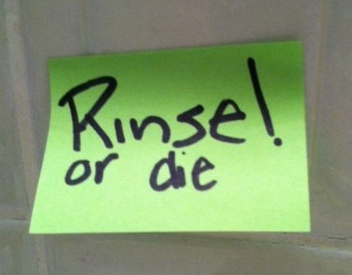
In case you can’t read that, it said “RINSE OR DIE!”
Parenting does not have to be a series of serious teaching lessons all put together. It can be easy to forget this. You can teach, love, learn and grow with fun and laughter. Have a child that asks obvious questions all the time? Find a code word, like “marshmallows” that tells them they are asking a question they already know the answer to and use it whenever they ask nonsense questions.
Kid: “What’s for dinner (while they are staring at you cooking a hamburger)”
Parent: “Marshmallows.”
Kid: “When are we going to get there?” (on a trip they have been on 100 times).
Parent: “When we pass the sign with the marshmallows on it.”
Kid: “Do I have to do my homework?”
Parent: “Just do it until you get to the part about the marshmallows.”

Marshmallow Nightmares!! (Photo credit: katerha)
It might drive them crazy, but it keeps you a little more sane while you focus on a fun way to fit more marshmallows into your life.
Laugh together over silly jokes or silly things they say. Make sure you are laughing with not at. No one like to feel like people are laughing at them but laughing together as a family brings your family closer and reminds us why we brought these “no-rent paying, mess making little people,” as my husband likes to say, into your home in the first place.
How do you laugh with your family? Please fell free to share a funny story that makes you smile 🙂
Finding a therapist for a traumatized and/or attachment disordered child

Some elementary school counselors use books and other media to help their counseling (Photo credit: Wikipedia)
As therapist who specializes in both trauma and attachment disorders, I can tell you it is important if you are searching for a therapist for one or both of these issues, that you find the right therapist for your child. Doing so will save you a lot of money and aggravation and is more likely to speed the healing time for your child. To start, look at my post on finding the right therapist for you or your child (you can find the link at the bottom of this post). With these particular children, and probably people with other specialized issues as well, there are further steps you would want to take to ensure that you have the right person. I see the steps for this particular issue as follows:
1. Figure out if your child has “only” trauma, or has trauma with attachment related issues. Here is the distinction, a child with trauma without attachment disturbance usually experienced a one time occurence, or something that happened over a relatively short period of time and was quickly identified. Trauma with attachment related issues is trauma that also impacts a child’s ability to bond with their caregivers in a healthy way, for example abuse or neglect by a primary caregiver or ongoing abuse or neglect that a child did not disclose. If you feel as though your child’s trust in adults to provide care for them has been altered significantly, you will want to see someone with knowledge of attachment related issues. To clarify this distinction, a teenager carrying on a short-term, secret relationship with a much older adult that they thought was younger or who was tricked into a situation where they kept a secret because they were breaking the rules when they were traumatized does not fall into this category of attachment disturbance. It is within reason to anticipate that teenagers will try to stretch or break the rules and it does not signify a break in a child’s core ability to trust that their parents will care for them. A teenager whose step sibling was abusing them for an extended period of time whenever their sibling came to stay at the home does fall under the category of possible attachment disturbance. The difference is the primary caregivers were around at the time of the trauma and did not know to stop it, while in the first example, the teen was doing an activity it would be reasonable to assume is developmentally expected but someone took advantage of them inappropriately. When in doubt, I would see someone who specializes in both trauma and attachment. If you find that there is an attachment related issue for your child’s situation, I would always make sure to take the child to a therapist that understands attachment because in order to work on attachment disorders or disturbance, you must know about trauma since the two go hand in hand.
2. Once you have determined whether you are looking for a therapist with trauma training or whether you need someone with an attachment and trauma focus, follow the steps from my first post on finding a therapist and ask these additional questions.
- What is your training in attachment and trauma?
- What recent trainings have you attended or conducted that relate to attachment and/or trauma?
- How do you conduct your sessions?
The answers to these questions, if you are talking to the correct therapist, should indicate that the person stays actively engaged in seeking training for attachment and trauma related issues. Additionally, an attachment specialist will indicate to you that you will be in the room for most, if not all, of the time that your child is in therapy with them. Attachment oriented therapy is significantly different in that a therapist focuses much more on your relationship with your child rather than their relationship with your child. In traditional therapy including therapy for singular trauma, you would take your child to see the therapist, you might check in with the therapist at the beginning or the end, then your child would see the therapist alone for the majority of the session.
While traditional therapy is effective with many children, for children with attachment disturbance, it can actually damage a child’s relationship with their parent. I have seen this happen, since a child with attachment disturbance has a tendency to reject caregivers, and, while they are alone with a therapist they may talk to their therapist about how terrible and difficult their parents are. The therapist and child will bond over this and the therapist shakes their head in disbelief, meanwhile they may be overlooking a parent who is really trying their hardest to meet the child’s needs while reinforcing for the child that the caregivers in their lives are, in fact, inadequate. Remember, children with attachment disturbance see adults as unsafe on some level and tend to fit them into these categories. A skilled attachment therapist will spot when a child is doing this and help them to retrain their system of trust by teaching them how to find trustworthy adults and by training the adults in their lives to be trustworthy in the way the child needs them to be. To learn more about attachment disturbance you can see my post linked below “What is attachment disorder?”
**A note to providers- I understand that you have seen parents who are, in fact, inadequate. For this post, I am assuming that a parent who cares enough to read this post is adequate because they are involved and caring enough to research this issue.
Stay tuned for my post on getting specialized treatment for your child- the things insurance companies won’t tell you that can help you get your child’s treatment paid for.
Related articles
- What is attachment disorder? (help4yourfamily.com)
- Finding the right counselor/therapist for you and your family (help4yourfamily.com)
- How to know when you or your child need a therapist (help4yourfamily.com)
The Perils of Perfectionism in Parenting

Photo taken by me as an example of a stay at home dad and kids. (Photo credit: Wikipedia)
Written by, Kate Oliver, MSW, LCSW-C
Quite a few recent books have alluded to just how fed up parents are with people expecting them to be the perfect parent. Scary Mommy, by Jill Smokler, was just released this week and details confessions of real parents who feel all the feelings that go along with parenting that we often do not talk about such as, anger, isolation, depression, fear, and embarrassment. In this age where so much of what we do is recorded and we see so many recorded images of parents on reality television, it also seems like everyone is judging everyone else’s performance all the time. When we do this, we can wind up in a seemingly endless cycle of judging others and ourselves constantly without any relief in sight. In fact, there are several studies that have come out in the past few years stating that parents are significantly less happy than non-parents. I believe part of this is our unrealistic, perfectionistic tendencies during which the thought patterns can begin to get quite vicious.
My profession has not been much help in making parents feel much better either, I’m sorry to say. Not only do most of our books focus on what you can do for your children, rather than how to help you feel better so that you can be a better parent, we are constantly telling you how to improve communication with your child, have educationally enriching activities, spend quality time with your children and encouraging you to take constant care of their emotional needs. While all that stuff is nice and worthwhile in many ways, I think too much of it also takes away the important quality of being genuine with our children, you know, like the genuine feelings expressed in the popular picture book for adults “Go the F@$k to Sleep,” by Adam Mansbach. If you don’t know that book, take a moment to look it up on youtube and you can listen to Lawrence Fishburne read it to you- when your kids are not in the room. Really, isn’t that how most of us feel when our children are coming down six and seven times to say goodnight and asking to be tucked in even though we already tucked them in?
Here is what I think many parents are wanting and it is something we hear all the time about everything but being perfect parents… everything in moderation! Yes, even lovey, touchy stuff. It’s actually good for the kids to understand that their parents feel- gasp!- genuine emotions. If you are fakey, fakey all the time and pretend things are nice, they know it’s BS anyway and later they call you on it- I’ve seen it too many times to have any doubt about this. And you know, many times when our kids call us on stuff they are right. Has your child ever said anything to you like my daughter when she said, “Mom, that’s what you say when you’re not really listening?” She was right. I had no idea what she just said. That’s the daughter my husband and I joke that someone must have told her in the end she will get paid per spoken word because she sure does act like it. You bet I zone out the chatter sometimes and maybe even miss important things. As one of my favorite professors in my Master’s program said, one of the great thing about people is that if you miss something important they said the first time around, they are pretty certain to repeat it. I know this is true for my daughter too. Now, don’t get me wrong, remember- everything in moderation, so it is also important to take time to turn on our listening ears for our children every day, but I also want to be realistic that it feels quite impossible to be in the moment and listening to one child while the other is asking you to make them a peanut butter sandwich.
Another reason genuine = good with our children is that they, like us, are humans too! They are often not perfect and they need a good example of how to recover from imperfection. I give my kids lots of opportunities to witness imperfection without even trying that hard. I’m a real natural 🙂 I burn things, forget stuff, and plan poorly sometimes. Most parents do. It’s the ones that admit it and give children an example of how to recover via apology, forgiveness of self and others, humor, etc. that have happy, not entitled (another by-product of over-perfect parenting), healthy children with a good sense of who they are and who their parents are.
Dare to be perfectly imperfect! Your kids will thank you for it.
Related articles
- Parental Reframes When Things Don’t Look So Good (help4yourfamily.com)
- Two things your kids tell their therapists about you (help4yourfamily.com)
Parenting with affirmations

what are word for? (Photo credit: Darwin Bell)
Written by, Kate Oliver, MSW, LCSW-C
My children are learning new and wonderful things every day.
I am loving and supportive to my children.
My children are loving toward me.
As a huge fan of Louise Hay, the mother of the self-help movement, I have come to find the wonderful healing work that can be done via the use of affirmations. Ms. Hay would tell you that every statement is an affirmation. Typically we think of affirmations being statements we say to help us to feel better. I am loving and loveable is a common affirmation people try to say over and over to help change internal beliefs. But people can also say other, unhealthy or damaging affirmations, without even realizing they are doing so. I hear affirmations all the time like this, for example: everything I do turns out wrong, and it seems like everyone I love leaves me. I know it may seem simplistic to say that affirmations can change things but take a moment to see if you can remember words that may have changed your life. Hurtful words, loving words, thoughtful words, all may have played a part in helping you to form who you are.
I remember overhearing my mother say once that my sister was a smart as I was pretty. These words carried a lot of meaning for my twelve year old self. From them I deduced that my mother thought I was pretty (nice), but not that smart (ouch). While I know she would never have wanted me to feel like I was not smart and she has told me many times since that I am smart, I know that those words were powerful and impacted how I felt about myself. As parents our words are formative for our children. In the same way we can use affirmations to help us feel better about ourselves and to retrain our brains and our internal belief systems, we can use them to help our children form their own internal beliefs and set of understandings about how to feel better when life is hard.
One good introduction to affirmations for children is Louise Hay’s children’s book, I Think, I Am. In it, Hay uses child friendly language to teach children the power of affirmations. I have been using affirmations in my parenting for well over a year now, and can tell you it has made a huge difference in my children’s day to day happiness (mine as well). One thing that I think keeps people away from using affirmations is that they believe all affirmations have to be said in this nicey, nicey tone that feels syrupy and sweet. In my time using affirmations with my children, I can tell you this is absolutely not so!
My then six year old daughter, used to have reactions ranging from grumpy and reluctant to downright nasty upon waking up each morning. I actually got pretty irritated with going in to her room each morning to wake her up with a nice song only to be greeted with a moan that I needed to stop singing and demands for me to help her get dressed. However, I was determined to stay positive toward her and to try to set limits. One day, I got fed up with it and said quite firmly something along the lines of, “You know, the things you say right when you get up set the tone for your day. Do you want to wake up saying how rotten things are all the time or would you like to start your day showing love for all you have?” Here comes the affirmation, which I then stated out loud. “I am chosing to start my day happy and to be around people who are being kind to me.” Then I walked out of her room. I can assure you that I did not sound remotely close to sweet and syrupy. I also stated that I was going to take care of myself by leaving the room because I did not want to start my day feeling angry and sour. I believe my tone and questions are what caused my daughter to sit up and took notice. Within a few minutes she had dressed herself and come downstairs to tell me she did want to start her day right. Since then she has mentioned this desire several times. Sometimes in the morning when I wake her up now she still mentions that today she is going to have a happy day and I can tell you that morning wake ups have completely changed for her making our entire morning smoother for everyone.
Perhaps this sounds too simplistic. I know it’s not always so easy because I know you might tell me how your child would follow you out of the room and around the house demanding that you do such and such or this or that. Affirmations are not magical. They do not immediately change the people around you just by you saying them, however, they do help you to change your inner world and your outer world is forced to change as well. Be what I call a “broken record” with your affirmations. As your child follows you around giving you a hard time, continue to state them out loud. It can be the same one over and over again- you know, the same way you have to say “no” twenty times before they get it.
Now that you have read this, I would strongly encourage you to take a moment now to think about the affirmations you are saying to and about your own children. Would you like to change them? If so, write down what you would like to change them to. Need help finding an affirmation? Give me a try. I’ve gotten pretty good at this 🙂
For more information about affirmations, I would strongly recommend you read Louise Hay’s classic book, You Can Heal Your Life. It has been around for a while but it is actually a timeless work. No time to read? I bought it off itunes and listened to it while walking and I highly recommend this way as well. You can easily find this book by clicking on the Amazon widget link at the top right of this page. Please read my disclaimer page first.

Cover of YOU CAN HEAL YOUR LIFE
Parental Reframes When Things Don’t Look So Good

through the frame (Photo credit: Wikipedia)
written by Kate Oliver, MSW, LCSW-C
Alright, so you did something you are not so proud of. Let’s be clear, we’re not talking about major screw ups- like anything that meets criteria for abuse or neglect- we’re talking the overly harsh words or failure to understand the depths of need of our child if they have been trying to tell us about a problem. You know, the things we routinely beat ourselves up for as parents. First of all, I want to say (I may have said this before and I will probably say it again because it is such a wonderful statistic) that being “good enough” to support a securely attached child means we meet their needs a mere 30-40% of the time. This is not meant to give permission not to meet your child’s needs, but serves more to allow us to forgive ourselves when we miss something or respond differently than we would have liked and to see some of the positives in otherwise difficult situations such as divorce, death of a loved one, illness, trouble at school or with friends. Parental reframes work in all kinds of situations.
What do I mean by parental reframe? Well, you know how you can take the same picture and put it in different frames to make it look different? Depending on the frame a picture is in, you may notice more of one thing or another. Life can be the same way. A large part of parenting, as I see it, is to help children (and ourselves) find the most appropriate, helpful frame to put our issues in. Notice, I did not say it was to shield children from all difficult situations. First of all, that is impossible and we would only be setting ourselves up for failure. Secondly, you would not want to do that since childhood is precisely the time we need to learn to handle difficulties while we have our parents to protect and guide us. We are there to help children frame the pain they will inevitably have- not to keep them from any pain. So, what is a parental reframe? It is taking a step back to look at the frame we have put around a situation, then asking ourselves if there may be another frame that we might like to use instead. There really are so few absolutes in life and really our reality can be framed in many different ways.
Take a look at the picture below.

Do you see the baby? If you are like me, it will take a minute for you to find it but once you do, you will see the baby was there all along. The toes are in the branches on the right, the head is made where the trees come together on the left. Once you see it, you can’t un-see it, even though it was there all along. That’s how a reframe is. We get stuck on a story: divorce ruins children for example, or maybe even a worry more universal to parents like the feeling that our child never helps around the house. These times are precisely the times when we need a reframe.
How in the world are you supposed to reframe issues, especially beliefs or worries about your child that feel deeply entrenched? Let’s start the easy way first. When you have a few minutes, stop and take a few breaths while you pause to see if you can think about this issue in another way. It can be easier to do this if you ask yourself what your most loving friend might say about this issue to you. Ask yourself if it is possible that there may be alternative possibilities from what you have come up with so far. If you think it would be helpful, take a moment to brainstorm other possibilities for the belief you are clinging to. After all, this is only a belief and there are very few absolute truths out there. Let’s take our example of kids that don’t help around the house. Is it possible they try to help in some ways, just not the ways you wish they would? Is it possible they need more instruction to help? Is it possible you are asking (or demanding) for help in ways that are not effective for your children? Do they have something going on that prevents them from focusing on helping you like their age, ability level, extra-curricular activities, schoolwork, etc?
Next, take a moment to consider what you would like to believe about your child. Create an affirmation about what you would like to believe. My child is helpful around the house in many ways. Think of ways this affirmation is true. Say the affirmation many times over the next few days. Point out when you child does helpful things and begin stating ways they can help you as if you expect them to do those things. Be surprised when they haven’t picked up their items off the dining room table!
Just changing our attitude about a situation can help our children to change theirs. I have seen this work too many times to think otherwise. I have many clients with attachment disorders. Many times when they first come to see me their parents lament about how they are constantly in trouble. Their parents, who usually adopted them at an older age, often adopted them with the desire to show them how wonderful life can be! These parents want their children to have new and exciting life opportunities and they come in so frustrated that their children continue to get into trouble that requires the parents to keep them home more over and over. We reframe the statement of “my child is constantly getting into trouble and can’t ever make good decisions” to “my child gets easily overwhelmed by new experiences and transitions.” When we re-frame the child’s acting out behaviors from “bad” to “overwhelmed” the feeling as a parent changes significantly as well from a hopeless stance, to protective. While the child may still not be allowed out to do much, the intent and feelings behind the parents decisions feel more loving and come across that way to the children.
I know this may all sound a bit Pollyannaish to people. Additionally, I do not want to say that a reframe on cleaning is the same as a reframe on divorce. However, there are helpful aspects to all experiences in life. If the technique of thinking it through is not working for you, please take a moment to read my previous blog “How to know if you or your child need a counselor” (link below). Reframes are a lot of what we therapists help people to do.
Having trouble with a reframe? Let me invite you to post the belief you need reframed, or a belief you have reframed and tell me how it worked. While I can not diagnose or treat via a blog, I would love to have feedback on this topic (or any others).
Related articles
- How to know when you or your child need a therapist (help4yourfamily.com)
- 4 Rules parents can live by (help4yourfamily.com)
- Two things your kids tell their therapists about you (help4yourfamily.com)
Discipline vs. punishment

FCC program offers child care, career – FMWRC – US Army – 100916 (Photo credit: familymwr)
written by Kate Oliver, MSW, LCSW-C
People might wonder why it is that I would wish to make a distinction between discipline and punishment since we often use the terms interchangeably. However, I believe there is an important distintion to make.
Discipline is a word that originates from the word “disciple” which means one who accepts and teaches the learnings of another. If you think about that word, and it’s origins, we can narrow it down to discipline being about teaching.
Punishment is different and mainly refers to inflicting consequences on another.

Deutsch: Historische Federzeichnung einer schulischen Körperstrafe. Handschriftlicher Begleittext in Original: Tyranis di Magistrum (Tyrannei des Lehrers). Randzeichnung im Buch Lob der Torheit von Erasmus von Rotterdam English: Schoolboy receiving bare bottom birching, from a medieval source (Photo credit: Wikipedia)
There is a quote we use in attachment to teach parents about how children learn to see themselves in the world. It is by Thomas Cooley, “I am who I think you think I am.” This is the truth for children. The full quote from Cooley is actually, “I am not who I think I am; I am not who you think I am; I am who I think you think I am.” I find this to be so true for every child I have ever seen with the “I” being the child and the “you” being their parents. Think about your own childhood. Did you come to know yourself as a child by virtue of what you thought your parents thought of you? Have you ever struggled with finding out who you are as you moved away from what your parents think of you and who you are, to be who you truely are? The same is and will be true for your children. They believe they are who you believe them to be. What does this have to do with punishment vs. discipline? It gives us a framework for making decisions about what to do when our children display behaviors we find undesireable (or desireable too). In many ways, we are Gods to them. They are your desciples. What will you teach them? Or, alternately, will you punish them for things you do not like?
In case you have not figured it out, I am all for discipline, not so much for punishment. As you will see in the other posts I have written and will keep writing, I do not believe that to teach children new behaviors we mush punish them. In fact, I think punishment tends to do the opposite by taking the focus off of the behavior and onto their relatonship with you and the conflict you are experiencing with each other.
So, what is the big deal and how will it look different day to day? Well, in the end, it may not look that different, the discipline framework I am referring to is more a question of the intent of you as a parent. When we come to our children as loving teachers, the same intervention can have a different feel to the child. For example, both a disciplinarian and a punisher might decide not to allow their child to go out the weekend after they break a curfew. However, the disciplinarian would say something like, “Sure, you can go out until 11pm after I have learned to trust you to come in by 10 reliably. Guess we’ll have to see whether you can do that next week. Tonight, I want you with me so I don’t have to worry about your safety like last time.” A punisher says something more like, “You were late last week. You know the rules, if you break curfew you’re in for a week.” The tone of discipline is on loving the child and expecting them to do their best for them and for you while punishment is more about, “I’m in charge and you’re in trouble.”
Lots of times discipline looks more forgiving and tolerant of a child’s choices and people can make the mistake that it is overly permissive. Please let me clarify that discipline allows more for natural consequences with the understanding that children can learn best by age appropriate experiences. An example of this would be allowing for a bad grade then remarking about how difficult it must be for your child to see themselves earn a grade that is beneath them. You could also remark on how you are surprised by the grade since you know they are a good student (I am who I think you think I am). Not only is discipline easier for us as parents (let’s face it- when your kids are punished so are you), in my view of it, we are teaching our children to love themselves and expecting that they will love and respect us in return. By expecting and giving love and respect as part of our ongoing give and take relationship with our children, we teach them that who they are is important and worthwhile while building the foundations of positive self-esteem that will last a lifetime.
4 Reminders to help the holidays go smoothly for everyone

9-7-4 Easter (Photo credit: cobalt123)
If you are a parent who is going to celebrate Easter or Passover this weekend please take a moment to remember a few things that will help the holiday’s go smoother.
1. Remember that your children have not done this holiday very many times yet. Even a ten-year old has only experienced this holiday 10 times and does not even remember the first two. Reviewing the expectations and schedule changes so kids can be prepared is very helpful. Will there be family gatherings that are different? Will you be playing outside finding eggs in your Sunday clothes? Is the church or synagogue service longer or done differently?
2. Remember that while we might be tense and/or worried about things like being around family members we don’t often see, or whether we will be able to pull off surprises for the kids, our children- while excited- are also picking up on the feelings and tone we set. If we overextend ourselves, our children will not have as good a time either. I can’t tell you how many times I have heard about the yearly parental meltdown around a holiday! This means, try to keep everyone on the same sleep schedule- including you. Eat and drink as needed… you get the picture.
3. Even though you already spoke with your child about what to expect for the holiday, if you are going anywhere else, gently remind them of the expectations again in the car on the way there. Also talk about adult’s expectations of them. You might be expecting them to act differently at grandma’s but they don’t know that unless you tell them, or after it’s already too late. You may even want to rehearse with a small child about what to do if they receive something unwanted. It is age appropriate for a child, even up to age six to ask if “that’s all” or to say they do not like something. Offer alternatives, like asking a parent quietly in the next room about whether more is coming to them, or saying thank you for a gift or treat they do not like.
4. Possibly most important. Allow yourself to be in and experience the joy of the present moment. Anything that goes wrong now are memories shared and as long as no one got permanently hurt- they are not disasters.
I hope everyone, whether you celebrate or not, has a wonderful weekend!
Related articles
- 4 Rules parents can live by (help4yourfamily.com)
Trash Your Behavior Charts!

Kids (film) (Photo credit: Wikipedia)
I have a pet peeve as both a parent and as a clinician about behavior charts. You know, those charts where kids get stickers for doing things they are supposed to be doing anyway, and then they get a treat or prize for doing it enough times? I am aware this opinion may be upsetting to some clinicians and especially school professionals where behavior charts are relied upon so heavily. As a parent, I just think they are annoying and hard to follow for me. As a clinician, I believe they set up a tit for tat system in a family where everyone starts measuring who did what when. For my parents with children with attachment disorder they are especially frustrating because by the time a child has earned the prize, you might feel as though you are so angry about all the work it took for you to get them to do the chore/ desired behavior that you don’t really feel like giving them anything. Sometimes kids make you sorry you gave the prize after the fact by deciding now that they earned the prize they don’t need to do anything for a while. What a pain.
I have a much better alternative to traditional behavior charts. It’s the only one that works and it requires little effort from you! This will take all of two minutes of your life. Here’s how it works:
- Take a piece of paper and write down one or two (I would only do a couple at a time because it’s easier to keep track of) things your child does that bug the heck out of you i.e. lying, “forgetting” to do their chores, sassing back. Pick something that is realistic for their developmental level.
- Think of a few prizes you might like to earn that involve self-care: a massage, getting a cup of tea with a friend, take a long bath, etc.
- Let your child know that you are now giving yourself a behavior chart. When you are able to successfully handle this behavior from your child in a manner you feel is appropriate (without you yelling, whining, engaging in a back and forth battle), you get a point! Decide how many points you need to earn to get a prize. Tell your child that when they engage in that behavior from now on you (not they) will earn a point.
- When they do engage in the behavior, calmly remark on what an opportunity this is for you to earn points so you can take care of yourself. It’s important for parents to take care of themselves when kids are giving them a hard time. You can wonder aloud how long it’s going to take to get your prize.
- This is the most important step. Follow through! When you earn your points, do the thing you said you would do to take care of yourself, even if you don’t feel like it. Remember you picked things you like to do so perhaps they can help you now.
I have successfully used this “behavior chart” with many parents now and I have used it myself. It works like a charm. I used it with my own daughters who kept coming in at night to have me take them back to bed when they had their normal cycle of lighter sleep. I modified it so that if one kid came in, she earned her sister a point! Guess who sleeps without interruption for weeks at a time? This lady, right here does! J It’s really a win-win either way since even if you don’t get the desired behavior right away (and you will because kids get annoyed at the idea of earning you a prize) you at least get some self-care.
Related articles
- What is attachment disorder? (help4yourfamily.com)
- Two things your kids tell their therapists about you (help4yourfamily.com)
About me

Kate Oliver, LCSW-C (Licensed Clinical Social Worker) has been a clinician working with traumatized and attachment-disturbed children for almost two decades. She is co-owner of A Healing Place, a private practice in Columbia, Maryland, since 2007.
At the beginning of her career, Kate found that while some children responded to traditional child therapy practices, there were a significant number of children who showed little or no improvement in their overall emotional well-being. This led her to seek out specialized training to learn more about attachment, the bond between parents and children, and found that by using attachment-based strategies in addition to treating trauma, even the most challenging children and their parents, saw major, life-changing shifts, not only for the children she was working with, but the parents as well.
Early in her career, Kate was privileged to work as the clinical director for Tamar’s Children, a program that took pregnant, incarcerated women from prison to a treatment facility that worked on teaching the women to bond with and attach to their babies, while also helping the women to heal their own broken attachments, and history of trauma and addiction. This program was internationally recognized for having a successful, evidence-based practice using an attachment-based model. From working with some of the most severely disenfranchised parents, Kate received important information about how to help all parents maintain a happy, healthy relationship with their children.
In 2007, Kate co-founded A Healing Place, a mental health private group practice in Columbia, Maryland, where she focuses on working with families with children who have a history of trauma and/or attachment disturbances. A board certified supervisor, Kate has been an invited presenter to teach continuing education courses for other social workers and psychologists. In her courses, Kate teaches attachment-building techniques and presents about her sub-specialty, working with families headed by gay and lesbian parents. Kate has also worked as a trainer for Building Families for Children, a therapeutic foster care agency.
Kate is a former board member for the organization COLAGE, a non-profit group that works toward community building for people with gay, lesbian, bisexual and/or transgender parents. She is currently a member of Attachment Disorders Maryland, a group that works to educate parents and professionals about working with children with attachment related issues. She is a Trust-Based Relational Intervention (TBRI) Practitioner and Educator.
Kate lives in Columbia, Maryland is the mother of two amazing daughters, the partner to a fantastic husband, and the daughter of one mother and two gay dads. She loves to read any book that crosses her path, write (of course), and she recently started dancing again, a passion she has had since her youth.
Kate can be reached by email: helpforyourfamily@gmail.com for questions or you can find her on Facebook: http://www.facebook.com/#!/Help4yourfamily.
-
Recent
- 6 Tips for Connecting with Your Teenager
- Updates and New Content on the Way
- Making Peace With Your Inner Critic
- Happy Parent Tip #1
- Why Sexual Abuse is Never a Child’s Fault…Not Even a Teenager
- Naming Patterns Changes Patterns
- This is your brain on attachment
- Last Chance for Two Great Opportunities
- Mother’s Retreat Weekend- It’s Really Happening!
- Stopping the Parent Shame and Blame Game
- Making Peace With Your Inner Critic
- Putting together something fun for you!
-
Links
 help4yourfamily