Is Chimpanzee good for your child to see if they are adopted or have lost a parent?

See description on File:Chimpanzee mom and baby.jpg. I cropped it slightly to remove the original black frame. (Photo credit: Wikipedia)
Written by Kate Oliver, LCSW-C
Just from watching the commercials, we can easily see that the new Disney movie, Chimpanzee, is going to be all about adoption. While it is predictable that the movie will have warm fuzzy messages about adoption overall, if you have an adopted child, or any child who has lost a parent through divorce, abandonment, death, etc. it is a good idea to take a moment to consider whether this is a good movie for your child. Of course we know all children are different and only you can decide what is right for your child so please do not use my post as a replacement for your own judgment since obviously you know your child way better than I do. Also, spoiler alert, you will know all about the movie by the time I’m done with the post. My hope is to attempt to address the adoption related issues in the movie so you can make the best decision for you and your family and to be ready for any conversations or feelings it might bring up for your child (and you).
First, let me say, the movie was pretty entertaining for the children seven and up in our group, the youngest (5) got bored half way through and I saw several younger children leave during the movie. The parents were thoroughly entertained and there were quite a few “aww’s” and chuckles throughout.
The movie starts in an idealic world where little monkeys are taken care of by mommies (no mention of daddies). Little Oscar and his mom, Esha, are the focus. Children who were not taken care of by their first mommies or whose first mommies have left them in some way may have some feelings about the portrayal of moms in this part as the idea of mommies taking care of babies is presented as the only way things can go. I can see how a child who feels bad about having a mommy who did not take care of them might be triggered if they carry residual feelings of guilt or believe it was their fault their birth mother did not take care of them. Additionally, the mention of dads is not just downplayed, it is completely non-existant in this part of the movie.
Soon, the idealic world of the chimps is threatened by another group of chimpanzees who want to take over their territory. Esha keeps Oscar safe during a particularly scary time when this group attacks and the movie continues to highlight Oscar’s reliance on his mother and her role in keeping him safe, fed and protected. Sadly, the other group of monkeys attacks a second time and it is during this attack that Esha and Oscar are separated and Esha disappears forever with the assumption being that only death could keep her away. It continues to be quite heartbreaking as we see Oscar get harshly rejected by several other female chimpanzees who already have children (triggering for children who have been in multiple foster care placements). During this time, Oscar tries, and fails, to find his mother. Obviously, no one is able to explain to him where she is and he is left to fend for himself. Oscar is sad and lonely and experiences difficulty finding food and caretaking. Do I need to point out the many opportunities for adopted children and/or children who have a parent that is not in their lives will have to identify strongly with this section of the movie?
After suffering for an intense ten minutes or more during the movie, Oscar begins to follow the alpha male, Freddy. He begins gently befriending Freddy (there is a good conversation to be had about shadowing adults and learning from thier modeling behaviors here). Freddy, who it was earlier emphasized in the movie, had no interest in the younger chimps, slowly also begins turning toward Oscar and teaching him to get food. Over time, their friendship grows and, in a particularly heartwarming scene, Freddy grooms Oscar and lets him ride on his back.
During this portion of the movie, there is no mention of moms and, knowing that I see children with attachment disorder in my practice who work pretty hard to come between their parents and who often punish the mom and complian to the dad (because moms are scary for them since they represent the original abandoning mom), I can see this particular part of the movie reinforcing that behavior a bit. Additonally, I can see how children who have struggled to bond with an adoptive parent would be triggered to wonder what it is about them that caused them to be first rejected or abandoned by other parents if that is their emotional experience. Those children who struggled to bond with an adoptive parent may also wonder why it is so easy for Oscar (no internal loyalty struggle here, also no negative behaviors from Oscar) to bond with Freddy and just what must be wrong with them that they have difficulty bonding.
While Freddy and Oscar are bonding, however, trouble lurks nearby, the narrator, Tim Allen, says that while Freddy and Oscar have been building their relationship, Freddy has neglected to protect his area and the other chimpazee group is closing in for another attack. Freddy senses this and begins to do some team building again. Oscar feels ignored by his new dad and we see him again feeling lonely because he does not understand why Freddy is turning away from him to take care of other chimps. This made me think about moms or dads taking care of new babies or other siblings and the triggers that has for many of my adopted children, not to mention kids in step-parent families.
I can see this movie being especially nice for single and/or adoptive dads as it reinforces that dads always protect their children even if they didn’t always know how to parent at first. I can also see it being an issue for moms and other primary, nurturing caregivers (including dads) who, like I said before, have a child that uses them as a representation of all abandoning people in their lives, and for children who did not have a mother that took good enough care of them before entering an adoptive family. I would also recommend it for children who are able to articulate their feelings about adoption, parental loss, etc. over children who are still unable, or unwilling to discuss those issues. Ultimately, it is up to parents to decide what is right for their children. Either way, in the end, the movie has a happy ending where Freddy and Oscar get to be together and Freddy focuses on Oscar again.
I see multiple opportunities for parents to bring up good conversations for kids about: whether Esha’s disapperance was Oscar’s fault; how Oscar must have felt when the other mom’s rejected him; how Oscar befriended Freddy and whether they loved each other right away; how dads and other parents protect children even though sometimes it is hard to see how (like when they go to work or pay attention to other kids); and why Oscar had an easier time of bonding with Freddy (because his first mom was good at teaching him how to love other chimps).
Have you taken your child to see this movie? What did you think? Did I miss anything? I would love to hear how the experience was for your child.
Qualities of good programs to prevent child abuse

PEARL HARBOR (April 23, 2010) Mara MacDonald, from the Navy New Parent Support Home Visitation Program, leads a group of new mothers and their babies in an infant massage class. The program is administered by the Navy Region Hawaii Fleet & Family Support Center and assists new parents and expecting parents with home visits, information on parenting, referrals, support groups and nurturing skills. (U.S. Navy photo by Mass Communication Specialist 1st Class Jason Swink/Released) (Photo credit: Wikipedia)
In my final post (for now) about programs to prevent child abuse, I thought I would highlight some qualities of programs I have seen that effectively work to prevent child abuse. As a reminder, my original start to this series of posts was a question posed on another blog about how we can prevent child abuse and child deaths.
1. The first quality any program providing aid to people who could use parenting help is compassion/ empathy. I know this may seem like a no-brainer, but some programs I have seen seem to leave this element out. No one wants to go to a program to hear how awful they are, thus confirming their internal fear that they are, in fact, awful. A compassionate program understands that all parents experience fear, that we are all doing the best we can, and that none of us have children thinking we are looking forward to messing them up as much as possible. Acknowledging this over and over is an important part of any program seeking to help parents.
2. Normalizing getting help is an incredibly important part of any program seeing to end child abuse. Highlighting the diversity of parents, race, class, and gender, who seek help is also incredibly helpful. This is, in my opinion, best achieved by having mentors that have completed the same or a similar program and are a representation of the general client population of the program. For example, if this is a program aimed toward parents experiencing postpartum depression, you would want a parent mentor or group leader who has experienced this and is regularly available to participants.
3. Good programs focus on the importance of parents in a child’s life. For regular followers of my posts, you know I had to mention attachment :). But seriously, the cornerstone of a good program that prevents child abuse absolutely needs to highlight the impact parents have on their children. I think people sometimes think it is a given that parents know how important they are to their children, but for people struggling with parenting- perhaps people whose parents were not ideal either- I find that many of these parents feel disempowered to make change in their child’s life. A good program reminds a parent of just how important they are.
4. The final quality I would like to highlight is that a good program helps people to build a supportive community. Good programs build communities so that if the program is ever unavailable, the learning and growing continues among the members of the community.
Some good programs I know of in my area are:
The Healthy Families program where parents are met in the hospital by someone from the program and are given support if they request it. Support can include getting help with access to services or forming a group of other new parents in the community. While there are healthy families programs all over the country, you can find the one near me here: http://www.hopkinsmedicine.org/howard_county_general_hospital/services/mothers_and_babies/healthy_families/index.html
The National Family Resiliency Center (NFRC) is a center for families experiencing a family transition and for parents where there is any need for co-parenting agreements. NFRC has been a national leader in helping court systems to recognize that when parents separate it is important to keep in mind the best interests of the child. They provide individual, couples, group counseling for parents and children, reunification and collaborative divorce services as well as very good classes for parents and children who are experiencing the transition process. Additionally, NFRC helps parents who would like to have co-parent agreements and low-conflict divorce. One way they do this is with an on-line program, www.familyconnex.org to help parents make decisions that are in the best interests of the children. Here is the link to NFRC’s website: www.nfrchelp.org
The Infants and Toddlers program, which is part of the educational system but may go by different names in other states, identifies infants who may have developmental delays and helps parents by offering resources for children birth-5 years with the combination of services they might need to get them school ready. You can find them here: http://marylandpublicschools.org/MSDE/divisions/earlyinterv/infant_toddlers/about/message.htm
There are many more, but these programs I mentioned in particular, although they target different populations, offer the combination of qualities important for a program aiming to prevent child abuse. While they might not even directly target child abuse, they are organizations that can recognize and report possible abuse, and that may help to prevent it in the first place though education and service.
What do you think? Do you know of any good programs that have been effective in your area in preventing abuse? I would love to hear about them. Also, did I miss any qualities of effective programs to help parents?
Laugh and your family laughs with you

Written by, Kate Oliver, LCSW-C
After a couple of days of heavy posts, it’s time to lighten the mood. I’ll post about good programs tomorrow like I said I would, but for now, let’s talk about bringing a little light and levity to our everyday life with our children. Sometimes, all you can do is laugh…or cry. I would encourage you to laugh. Sure, I could tell you about all the research that tells you that laughter is, indeed, the best medicine for many situations, but you can easily look that up, or you can just trust me on this one. Laugh more. Build humor into your family system. Make sure that your children understand your humor (even if they do not like it). Most importantly, teach your children to laugh at themselves by laughing at yourself. My younger daughter does an impression of my husband when he is telling her to clean up that is hilarious. We all laugh, then we clean up.
This morning, when I grumbled at my older daughter to rinse her mouth after brushing her teeth (who doesn’t rinse after you went to the trouble of brushing!?) because I’m tired of paying an extra car payments worth of money every time we go to the dentist, I went up to the bathroom after she went to school and found a post-it note she put up in the bathroom to remind herself to rinse:
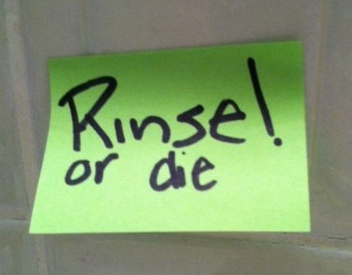
In case you can’t read that, it said “RINSE OR DIE!”
Parenting does not have to be a series of serious teaching lessons all put together. It can be easy to forget this. You can teach, love, learn and grow with fun and laughter. Have a child that asks obvious questions all the time? Find a code word, like “marshmallows” that tells them they are asking a question they already know the answer to and use it whenever they ask nonsense questions.
Kid: “What’s for dinner (while they are staring at you cooking a hamburger)”
Parent: “Marshmallows.”
Kid: “When are we going to get there?” (on a trip they have been on 100 times).
Parent: “When we pass the sign with the marshmallows on it.”
Kid: “Do I have to do my homework?”
Parent: “Just do it until you get to the part about the marshmallows.”

Marshmallow Nightmares!! (Photo credit: katerha)
It might drive them crazy, but it keeps you a little more sane while you focus on a fun way to fit more marshmallows into your life.
Laugh together over silly jokes or silly things they say. Make sure you are laughing with not at. No one like to feel like people are laughing at them but laughing together as a family brings your family closer and reminds us why we brought these “no-rent paying, mess making little people,” as my husband likes to say, into your home in the first place.
How do you laugh with your family? Please fell free to share a funny story that makes you smile 🙂
The Problem with Social Services- part II

Mother holds Child (Photo credit: Wikipedia)
In my post yesterday, I outlined some of the problems with the implementation of Social Services. Today, I will be discussing support for CPS and social workers in general. You can see from what you read already that in many ways workers are bound to the law of their area for decision-making purposes. I am certain that every CPS worker you will ever speak to has a child, or several children, that they wish they could have removed because they could see the train wreck coming. Similarly, they will also have a child they were sad to remove, and parents that surprise them with their resiliency, cruelty, etc. Just when you think you’ve seen it all, they have seen more. Yet, how much do we hear about CPS workers, or any social workers, for that matter getting recognition for the difficult work they do? In many ways CPS workers are damned if they do and damned if they don’t in most situations. The cases that get highlighted are the extremes where children were taken from the home with little apparent reason or children that were not removed from the home who died. There are almost always people who are upset with the decisions of the workers- people who feel neglect or abuse is occurring get angry because they want CPS workers to be more proactive, and people who feel the parents are doing the best they can, or have a right to parent however they see fit even if it borders on abuse want CPS workers to mind their own business. I do not mean to make any excuses over children improperly removed or children who are left in the home who suffer further abuse or fatality but I do want to say that with the high caseloads expected of caseworkers, the low-level of support and the high burnout rate of workers, mistakes are bound to happen. While I’m mentioning this, another potential area for legal changes could be mandating a particular number of children on a workers caseload just like school districts have a student; teacher ratio.
In addition to having incredibly difficult jobs and little public understanding of their role, CPS workers do this with very little financial support. While I was not working as a CPS worker, after earning my master’s degree and going to work in a treatment facility for abused children, I got very little compensation. By comparison, my sister, who was getting her undergraduate degree in computer science, made more at her internship than I was making at my job. I left that job five years later, with many tears on my part because I did love my work and I was in a supportive atmosphere. The final straw for me was after I had two children and my husband and I were in a Home Depot one day where two employees happened to be comparing paychecks while we were checking out. One of them mentioned how much money he was making an hour and I realized I was making only a dollar an hour more than he was. Even though my husband works hard, we do need my paycheck and I realized I needed to earn more money to justify being away from my babies. The average income of a full-time CPS worker is about 30-35,000 which is in the high range for social workers outside of private practice. If you compare what social workers and teachers do, we can make many of the same arguments about being expected to purchase materials in excess of what is provided and work hours outside of paid time, etc. Yet teachers have the support of the public. When’s the last time you saw a discount for social workers to get into a museum or social worker night at the pizza place? I’m guessing never.
My point is not to whine, my point is to say that one thing we could really use is some marketing. Right now the cons of getting involved in child welfare in general outweigh the pros for anyone who relies on their paycheck to put food on the table. If I had a dollar for every time in my master’s program I was told we were not in social work for the money, I would be rich. Bottom line, we need to support the intent of social services- to protect children and prevent child abuse, to advertise the opportunities that social services can help struggling parents with, and to better compensate and support our workers so we attract the best of the best. As part of a larger marketing campaign, we need to educate people about the current role of social services (while taking responsibility for past mistakes), focusing on people of color, immigrants and the very poor as in the past the United States has improperly targeted these groups and there is, in my opinion understandably, a generation of people who carry the fear that their children will be taken should they seek assistance or raise a question to anyone about how to be a better parent.
While you may believe that focusing on CPS is missing the point of supporting child abuse prevention, I believe it is very pertinent to the discussion. According to PBS’s Frontline website, only about 60% of the cases referred to CPS are actually found to need further investigation, however, even without finding a child has been abused, often the local Department of Social Services can offer families help in signing up for programs that include child care, food and medical assistance, and parenting classes. A 2002 report for the Urban Institute says that about $20 million was spent that year on child welfare services. Compare this to the Humane Society’s $160 million budget to protect animals. I have nothing against animals (I’m actually a vegetarian) but seriously? This is shameful! People will give money all day long to protect animals, but when it comes to children, for the most part, people do not want to hear about it, talk about it or think about it. I think too, we assume services are out there and available when really, they are not as available as we would like to think. De-stigmatizing aid and increasing wages to hire the best workers would dramatically change the impact of Social Services in preventing child abuse.
Tomorrow, I will highlight what I believe to be the cornerstones of a good child abuse prevention program.
The Perils of Perfectionism in Parenting

Photo taken by me as an example of a stay at home dad and kids. (Photo credit: Wikipedia)
Written by, Kate Oliver, MSW, LCSW-C
Quite a few recent books have alluded to just how fed up parents are with people expecting them to be the perfect parent. Scary Mommy, by Jill Smokler, was just released this week and details confessions of real parents who feel all the feelings that go along with parenting that we often do not talk about such as, anger, isolation, depression, fear, and embarrassment. In this age where so much of what we do is recorded and we see so many recorded images of parents on reality television, it also seems like everyone is judging everyone else’s performance all the time. When we do this, we can wind up in a seemingly endless cycle of judging others and ourselves constantly without any relief in sight. In fact, there are several studies that have come out in the past few years stating that parents are significantly less happy than non-parents. I believe part of this is our unrealistic, perfectionistic tendencies during which the thought patterns can begin to get quite vicious.
My profession has not been much help in making parents feel much better either, I’m sorry to say. Not only do most of our books focus on what you can do for your children, rather than how to help you feel better so that you can be a better parent, we are constantly telling you how to improve communication with your child, have educationally enriching activities, spend quality time with your children and encouraging you to take constant care of their emotional needs. While all that stuff is nice and worthwhile in many ways, I think too much of it also takes away the important quality of being genuine with our children, you know, like the genuine feelings expressed in the popular picture book for adults “Go the F@$k to Sleep,” by Adam Mansbach. If you don’t know that book, take a moment to look it up on youtube and you can listen to Lawrence Fishburne read it to you- when your kids are not in the room. Really, isn’t that how most of us feel when our children are coming down six and seven times to say goodnight and asking to be tucked in even though we already tucked them in?
Here is what I think many parents are wanting and it is something we hear all the time about everything but being perfect parents… everything in moderation! Yes, even lovey, touchy stuff. It’s actually good for the kids to understand that their parents feel- gasp!- genuine emotions. If you are fakey, fakey all the time and pretend things are nice, they know it’s BS anyway and later they call you on it- I’ve seen it too many times to have any doubt about this. And you know, many times when our kids call us on stuff they are right. Has your child ever said anything to you like my daughter when she said, “Mom, that’s what you say when you’re not really listening?” She was right. I had no idea what she just said. That’s the daughter my husband and I joke that someone must have told her in the end she will get paid per spoken word because she sure does act like it. You bet I zone out the chatter sometimes and maybe even miss important things. As one of my favorite professors in my Master’s program said, one of the great thing about people is that if you miss something important they said the first time around, they are pretty certain to repeat it. I know this is true for my daughter too. Now, don’t get me wrong, remember- everything in moderation, so it is also important to take time to turn on our listening ears for our children every day, but I also want to be realistic that it feels quite impossible to be in the moment and listening to one child while the other is asking you to make them a peanut butter sandwich.
Another reason genuine = good with our children is that they, like us, are humans too! They are often not perfect and they need a good example of how to recover from imperfection. I give my kids lots of opportunities to witness imperfection without even trying that hard. I’m a real natural 🙂 I burn things, forget stuff, and plan poorly sometimes. Most parents do. It’s the ones that admit it and give children an example of how to recover via apology, forgiveness of self and others, humor, etc. that have happy, not entitled (another by-product of over-perfect parenting), healthy children with a good sense of who they are and who their parents are.
Dare to be perfectly imperfect! Your kids will thank you for it.
Related articles
- Parental Reframes When Things Don’t Look So Good (help4yourfamily.com)
- Two things your kids tell their therapists about you (help4yourfamily.com)
Parental Reframes When Things Don’t Look So Good

through the frame (Photo credit: Wikipedia)
written by Kate Oliver, MSW, LCSW-C
Alright, so you did something you are not so proud of. Let’s be clear, we’re not talking about major screw ups- like anything that meets criteria for abuse or neglect- we’re talking the overly harsh words or failure to understand the depths of need of our child if they have been trying to tell us about a problem. You know, the things we routinely beat ourselves up for as parents. First of all, I want to say (I may have said this before and I will probably say it again because it is such a wonderful statistic) that being “good enough” to support a securely attached child means we meet their needs a mere 30-40% of the time. This is not meant to give permission not to meet your child’s needs, but serves more to allow us to forgive ourselves when we miss something or respond differently than we would have liked and to see some of the positives in otherwise difficult situations such as divorce, death of a loved one, illness, trouble at school or with friends. Parental reframes work in all kinds of situations.
What do I mean by parental reframe? Well, you know how you can take the same picture and put it in different frames to make it look different? Depending on the frame a picture is in, you may notice more of one thing or another. Life can be the same way. A large part of parenting, as I see it, is to help children (and ourselves) find the most appropriate, helpful frame to put our issues in. Notice, I did not say it was to shield children from all difficult situations. First of all, that is impossible and we would only be setting ourselves up for failure. Secondly, you would not want to do that since childhood is precisely the time we need to learn to handle difficulties while we have our parents to protect and guide us. We are there to help children frame the pain they will inevitably have- not to keep them from any pain. So, what is a parental reframe? It is taking a step back to look at the frame we have put around a situation, then asking ourselves if there may be another frame that we might like to use instead. There really are so few absolutes in life and really our reality can be framed in many different ways.
Take a look at the picture below.

Do you see the baby? If you are like me, it will take a minute for you to find it but once you do, you will see the baby was there all along. The toes are in the branches on the right, the head is made where the trees come together on the left. Once you see it, you can’t un-see it, even though it was there all along. That’s how a reframe is. We get stuck on a story: divorce ruins children for example, or maybe even a worry more universal to parents like the feeling that our child never helps around the house. These times are precisely the times when we need a reframe.
How in the world are you supposed to reframe issues, especially beliefs or worries about your child that feel deeply entrenched? Let’s start the easy way first. When you have a few minutes, stop and take a few breaths while you pause to see if you can think about this issue in another way. It can be easier to do this if you ask yourself what your most loving friend might say about this issue to you. Ask yourself if it is possible that there may be alternative possibilities from what you have come up with so far. If you think it would be helpful, take a moment to brainstorm other possibilities for the belief you are clinging to. After all, this is only a belief and there are very few absolute truths out there. Let’s take our example of kids that don’t help around the house. Is it possible they try to help in some ways, just not the ways you wish they would? Is it possible they need more instruction to help? Is it possible you are asking (or demanding) for help in ways that are not effective for your children? Do they have something going on that prevents them from focusing on helping you like their age, ability level, extra-curricular activities, schoolwork, etc?
Next, take a moment to consider what you would like to believe about your child. Create an affirmation about what you would like to believe. My child is helpful around the house in many ways. Think of ways this affirmation is true. Say the affirmation many times over the next few days. Point out when you child does helpful things and begin stating ways they can help you as if you expect them to do those things. Be surprised when they haven’t picked up their items off the dining room table!
Just changing our attitude about a situation can help our children to change theirs. I have seen this work too many times to think otherwise. I have many clients with attachment disorders. Many times when they first come to see me their parents lament about how they are constantly in trouble. Their parents, who usually adopted them at an older age, often adopted them with the desire to show them how wonderful life can be! These parents want their children to have new and exciting life opportunities and they come in so frustrated that their children continue to get into trouble that requires the parents to keep them home more over and over. We reframe the statement of “my child is constantly getting into trouble and can’t ever make good decisions” to “my child gets easily overwhelmed by new experiences and transitions.” When we re-frame the child’s acting out behaviors from “bad” to “overwhelmed” the feeling as a parent changes significantly as well from a hopeless stance, to protective. While the child may still not be allowed out to do much, the intent and feelings behind the parents decisions feel more loving and come across that way to the children.
I know this may all sound a bit Pollyannaish to people. Additionally, I do not want to say that a reframe on cleaning is the same as a reframe on divorce. However, there are helpful aspects to all experiences in life. If the technique of thinking it through is not working for you, please take a moment to read my previous blog “How to know if you or your child need a counselor” (link below). Reframes are a lot of what we therapists help people to do.
Having trouble with a reframe? Let me invite you to post the belief you need reframed, or a belief you have reframed and tell me how it worked. While I can not diagnose or treat via a blog, I would love to have feedback on this topic (or any others).
Related articles
- How to know when you or your child need a therapist (help4yourfamily.com)
- 4 Rules parents can live by (help4yourfamily.com)
- Two things your kids tell their therapists about you (help4yourfamily.com)
Discipline vs. punishment

FCC program offers child care, career – FMWRC – US Army – 100916 (Photo credit: familymwr)
written by Kate Oliver, MSW, LCSW-C
People might wonder why it is that I would wish to make a distinction between discipline and punishment since we often use the terms interchangeably. However, I believe there is an important distintion to make.
Discipline is a word that originates from the word “disciple” which means one who accepts and teaches the learnings of another. If you think about that word, and it’s origins, we can narrow it down to discipline being about teaching.
Punishment is different and mainly refers to inflicting consequences on another.

Deutsch: Historische Federzeichnung einer schulischen Körperstrafe. Handschriftlicher Begleittext in Original: Tyranis di Magistrum (Tyrannei des Lehrers). Randzeichnung im Buch Lob der Torheit von Erasmus von Rotterdam English: Schoolboy receiving bare bottom birching, from a medieval source (Photo credit: Wikipedia)
There is a quote we use in attachment to teach parents about how children learn to see themselves in the world. It is by Thomas Cooley, “I am who I think you think I am.” This is the truth for children. The full quote from Cooley is actually, “I am not who I think I am; I am not who you think I am; I am who I think you think I am.” I find this to be so true for every child I have ever seen with the “I” being the child and the “you” being their parents. Think about your own childhood. Did you come to know yourself as a child by virtue of what you thought your parents thought of you? Have you ever struggled with finding out who you are as you moved away from what your parents think of you and who you are, to be who you truely are? The same is and will be true for your children. They believe they are who you believe them to be. What does this have to do with punishment vs. discipline? It gives us a framework for making decisions about what to do when our children display behaviors we find undesireable (or desireable too). In many ways, we are Gods to them. They are your desciples. What will you teach them? Or, alternately, will you punish them for things you do not like?
In case you have not figured it out, I am all for discipline, not so much for punishment. As you will see in the other posts I have written and will keep writing, I do not believe that to teach children new behaviors we mush punish them. In fact, I think punishment tends to do the opposite by taking the focus off of the behavior and onto their relatonship with you and the conflict you are experiencing with each other.
So, what is the big deal and how will it look different day to day? Well, in the end, it may not look that different, the discipline framework I am referring to is more a question of the intent of you as a parent. When we come to our children as loving teachers, the same intervention can have a different feel to the child. For example, both a disciplinarian and a punisher might decide not to allow their child to go out the weekend after they break a curfew. However, the disciplinarian would say something like, “Sure, you can go out until 11pm after I have learned to trust you to come in by 10 reliably. Guess we’ll have to see whether you can do that next week. Tonight, I want you with me so I don’t have to worry about your safety like last time.” A punisher says something more like, “You were late last week. You know the rules, if you break curfew you’re in for a week.” The tone of discipline is on loving the child and expecting them to do their best for them and for you while punishment is more about, “I’m in charge and you’re in trouble.”
Lots of times discipline looks more forgiving and tolerant of a child’s choices and people can make the mistake that it is overly permissive. Please let me clarify that discipline allows more for natural consequences with the understanding that children can learn best by age appropriate experiences. An example of this would be allowing for a bad grade then remarking about how difficult it must be for your child to see themselves earn a grade that is beneath them. You could also remark on how you are surprised by the grade since you know they are a good student (I am who I think you think I am). Not only is discipline easier for us as parents (let’s face it- when your kids are punished so are you), in my view of it, we are teaching our children to love themselves and expecting that they will love and respect us in return. By expecting and giving love and respect as part of our ongoing give and take relationship with our children, we teach them that who they are is important and worthwhile while building the foundations of positive self-esteem that will last a lifetime.
4 Reminders to help the holidays go smoothly for everyone

9-7-4 Easter (Photo credit: cobalt123)
If you are a parent who is going to celebrate Easter or Passover this weekend please take a moment to remember a few things that will help the holiday’s go smoother.
1. Remember that your children have not done this holiday very many times yet. Even a ten-year old has only experienced this holiday 10 times and does not even remember the first two. Reviewing the expectations and schedule changes so kids can be prepared is very helpful. Will there be family gatherings that are different? Will you be playing outside finding eggs in your Sunday clothes? Is the church or synagogue service longer or done differently?
2. Remember that while we might be tense and/or worried about things like being around family members we don’t often see, or whether we will be able to pull off surprises for the kids, our children- while excited- are also picking up on the feelings and tone we set. If we overextend ourselves, our children will not have as good a time either. I can’t tell you how many times I have heard about the yearly parental meltdown around a holiday! This means, try to keep everyone on the same sleep schedule- including you. Eat and drink as needed… you get the picture.
3. Even though you already spoke with your child about what to expect for the holiday, if you are going anywhere else, gently remind them of the expectations again in the car on the way there. Also talk about adult’s expectations of them. You might be expecting them to act differently at grandma’s but they don’t know that unless you tell them, or after it’s already too late. You may even want to rehearse with a small child about what to do if they receive something unwanted. It is age appropriate for a child, even up to age six to ask if “that’s all” or to say they do not like something. Offer alternatives, like asking a parent quietly in the next room about whether more is coming to them, or saying thank you for a gift or treat they do not like.
4. Possibly most important. Allow yourself to be in and experience the joy of the present moment. Anything that goes wrong now are memories shared and as long as no one got permanently hurt- they are not disasters.
I hope everyone, whether you celebrate or not, has a wonderful weekend!
Related articles
- 4 Rules parents can live by (help4yourfamily.com)
Trash Your Behavior Charts!

Kids (film) (Photo credit: Wikipedia)
I have a pet peeve as both a parent and as a clinician about behavior charts. You know, those charts where kids get stickers for doing things they are supposed to be doing anyway, and then they get a treat or prize for doing it enough times? I am aware this opinion may be upsetting to some clinicians and especially school professionals where behavior charts are relied upon so heavily. As a parent, I just think they are annoying and hard to follow for me. As a clinician, I believe they set up a tit for tat system in a family where everyone starts measuring who did what when. For my parents with children with attachment disorder they are especially frustrating because by the time a child has earned the prize, you might feel as though you are so angry about all the work it took for you to get them to do the chore/ desired behavior that you don’t really feel like giving them anything. Sometimes kids make you sorry you gave the prize after the fact by deciding now that they earned the prize they don’t need to do anything for a while. What a pain.
I have a much better alternative to traditional behavior charts. It’s the only one that works and it requires little effort from you! This will take all of two minutes of your life. Here’s how it works:
- Take a piece of paper and write down one or two (I would only do a couple at a time because it’s easier to keep track of) things your child does that bug the heck out of you i.e. lying, “forgetting” to do their chores, sassing back. Pick something that is realistic for their developmental level.
- Think of a few prizes you might like to earn that involve self-care: a massage, getting a cup of tea with a friend, take a long bath, etc.
- Let your child know that you are now giving yourself a behavior chart. When you are able to successfully handle this behavior from your child in a manner you feel is appropriate (without you yelling, whining, engaging in a back and forth battle), you get a point! Decide how many points you need to earn to get a prize. Tell your child that when they engage in that behavior from now on you (not they) will earn a point.
- When they do engage in the behavior, calmly remark on what an opportunity this is for you to earn points so you can take care of yourself. It’s important for parents to take care of themselves when kids are giving them a hard time. You can wonder aloud how long it’s going to take to get your prize.
- This is the most important step. Follow through! When you earn your points, do the thing you said you would do to take care of yourself, even if you don’t feel like it. Remember you picked things you like to do so perhaps they can help you now.
I have successfully used this “behavior chart” with many parents now and I have used it myself. It works like a charm. I used it with my own daughters who kept coming in at night to have me take them back to bed when they had their normal cycle of lighter sleep. I modified it so that if one kid came in, she earned her sister a point! Guess who sleeps without interruption for weeks at a time? This lady, right here does! J It’s really a win-win either way since even if you don’t get the desired behavior right away (and you will because kids get annoyed at the idea of earning you a prize) you at least get some self-care.
Related articles
- What is attachment disorder? (help4yourfamily.com)
- Two things your kids tell their therapists about you (help4yourfamily.com)
4 Rules parents can live by

Happy Children Playing Kids (Photo credit: epSos.de)
About 15 years ago I went to a talk given by Joan Borysenko. During her talk, she said she was quoting from someone whose name she could not remember- I’ve tried to look it up since but I can’t figure out who said it either. What she said is that there are four rules for life: 1. Show up, 2. Pay attention, 3. Give what you have to give, 4. Don’t be connected to the results. I heard these words when I was still in college, before I became a therapist and a mother and they have resonated with me ever since, especially as a parent. I believe that if we all incorporate some of the wisdom of these words into our daily lives as parents then we will all be happier, and we will have happier children.
1. Show up. Turn off your cell phone and the television. If you can ever volunteer at school, do it- even if it is only one time a year. Be present with your child in the moment as much as possible.
2. Pay attention. Pay attention to what your child is trying to tell you. Is your child asking you to read a book or watch a television show they really liked? Maybe there is something in the book they really want to discuss with you. Is your child telling you something about himself or herself that you have not been willing to hear? Notice, this step does not say, “Pay attention and judge.” or “Pay attention and fix what you think is wrong.” It says “Pay attention.” Meditation is a good tool to help us(and our children) learn to be in the present moment.
3. Give what you have to give. Another way I think of this rule is “set boundaries.” Again, notice it does not say “give of yourself until there is nothing left.” I think we as parents can sometimes have a hard time with deciding what it is we have to give, whether it be money, time or attention to our children. To me, giving what I have to give means giving something freely to my children or someone else so long as I will not feel resentful or remourseful later that I gave it. This is a hard one but so important to model for our children.
4. Don’t be connected to the results. I would add that you cannot control them anyway and it is time for us all to stop pretending that we do. Sorry folks, but in parenting there are so many aspects of a child’s life that are so far out of our control that we never had a chance anyway. Oh sure we can pretend things are all our fault when they go right or wrong, but any parent with a child that was traumatized, or who grows up to be addicted to something will tell you that was never in their plan for their child. Sure you can monitor what your child is doing but do they ever get into a vehicle with you or someone else? Do you have a television, radio or computer in your home? Well, if you answered yes to any of these, you no longer control the results. Accidents happen, good people can be hurt, children can conduct secret lives right under our noses with no small thanks to technology. We can have the best of intentions and still things can go wrong.
Depressed yet? Please allow me to help with that. There are some things we can control. We can control our own actions. We can become aware of the ways in which we interact with our children and with others around us. We can be a safe, loving, soft place to fall for our children. We can model health and wellness for them in such a way that it would be difficult for them to ignore how wonderful it looks so they will be attracted to doing the same for themselves. Adding a spiritual practice is a good idea also if you believe in that kind of thing. A spiritual practice reminds us that our relationship with our children is just one important relationship and their relationship to their higher power is another (and is none of our business). Doing all of those things brings us right back to the first four steps I mentioned and allows us to live them with grace and dignity for ourselves and for our children.
Related articles
- Two things your kids tell their therapists about you (help4yourfamily.com)
About me

Kate Oliver, LCSW-C (Licensed Clinical Social Worker) has been a clinician working with traumatized and attachment-disturbed children for almost two decades. She is co-owner of A Healing Place, a private practice in Columbia, Maryland, since 2007.
At the beginning of her career, Kate found that while some children responded to traditional child therapy practices, there were a significant number of children who showed little or no improvement in their overall emotional well-being. This led her to seek out specialized training to learn more about attachment, the bond between parents and children, and found that by using attachment-based strategies in addition to treating trauma, even the most challenging children and their parents, saw major, life-changing shifts, not only for the children she was working with, but the parents as well.
Early in her career, Kate was privileged to work as the clinical director for Tamar’s Children, a program that took pregnant, incarcerated women from prison to a treatment facility that worked on teaching the women to bond with and attach to their babies, while also helping the women to heal their own broken attachments, and history of trauma and addiction. This program was internationally recognized for having a successful, evidence-based practice using an attachment-based model. From working with some of the most severely disenfranchised parents, Kate received important information about how to help all parents maintain a happy, healthy relationship with their children.
In 2007, Kate co-founded A Healing Place, a mental health private group practice in Columbia, Maryland, where she focuses on working with families with children who have a history of trauma and/or attachment disturbances. A board certified supervisor, Kate has been an invited presenter to teach continuing education courses for other social workers and psychologists. In her courses, Kate teaches attachment-building techniques and presents about her sub-specialty, working with families headed by gay and lesbian parents. Kate has also worked as a trainer for Building Families for Children, a therapeutic foster care agency.
Kate is a former board member for the organization COLAGE, a non-profit group that works toward community building for people with gay, lesbian, bisexual and/or transgender parents. She is currently a member of Attachment Disorders Maryland, a group that works to educate parents and professionals about working with children with attachment related issues. She is a Trust-Based Relational Intervention (TBRI) Practitioner and Educator.
Kate lives in Columbia, Maryland is the mother of two amazing daughters, the partner to a fantastic husband, and the daughter of one mother and two gay dads. She loves to read any book that crosses her path, write (of course), and she recently started dancing again, a passion she has had since her youth.
Kate can be reached by email: helpforyourfamily@gmail.com for questions or you can find her on Facebook: http://www.facebook.com/#!/Help4yourfamily.
-
Recent
- 6 Tips for Connecting with Your Teenager
- Updates and New Content on the Way
- Making Peace With Your Inner Critic
- Happy Parent Tip #1
- Why Sexual Abuse is Never a Child’s Fault…Not Even a Teenager
- Naming Patterns Changes Patterns
- This is your brain on attachment
- Last Chance for Two Great Opportunities
- Mother’s Retreat Weekend- It’s Really Happening!
- Stopping the Parent Shame and Blame Game
- Making Peace With Your Inner Critic
- Putting together something fun for you!
-
Links
 help4yourfamily