Monday is parenting affirmation day at Help 4 Your Family!
From now on, Monday is going to be parent affirmation day at Help 4 Your Family. Sometimes I will share affirmations I have created and used, other times I will quote affirmations from teachers I have come to trust.
For this Monday, May 7, 2012 your parenting affirmation is:
My children give me constant opportunities to learn and grow.
Now, you know this one makes you smile, even when you are tired. I would suggest that, to make this part of your self-talk, you repeat it many times throughout the day. Say it to yourself in the mirror, and mention it to your friends in conversations.
If you have a parenting affirmation that you would like to share, please feel free to let me know. Maybe you will see it some other Monday 🙂
All the best to your family,
Kate
Talking with Robert Holden

Robert Holden Ph.D (Photo credit: Wikipedia)
Written by, Kate Oliver, LCSW-C
On Thursday of this week I decided to try calling into one of my favorite radio shows, Robert Holden’s Shift Happens. It comes on at 1pm EST. Every Thursday is the day I stay home from the office and try to get enough done around my house so that my family and I can have a weekend free from running errands and picking up the house. I always listen to Hay House Radio using my phone app as I clean. If you don’t know about Hay House Radio, it is a station dedicated completely to positive radio programming. I love listening to Dr. Holden because he is always gentle and kind to everyone he speaks to and has a wonderful way of helping people to look at things in a different way.
I’ve had an unusual amount of anxiety lately, really since I started this blog. While I have taught other mental health professionals and parents in educational seminars, I’ve never publicly shared my writing until now and I have been feeling, well…vulnerable. So, I called into the show, anticipating a busy signal. How surprised was I when the phone rang and someone asked me what my reason was for calling before putting me back on hold? Umm, pretty surprised. I am so grateful for the time I had on hold so that I could gather my thoughts. Then, just after the commercial break, I heard Dr. Holden announcing…me! What a wonderful, effortless surprise :).
I know most people hate public speaking. I actually love it. I know I have good, worthwhile information to share and I love being with people as we all gain knowledge together. When I am in front of an audience, I can see people responding and adjust accordingly. But with this blogging thing, it’s like I’m putting my baby out into the world and it’s difficult for me to see how people are responding. When speaking in front of an in-person audience, I also know who is there (no one I know personally) and it is easy for me, in a professional setting, to shrug off criticism. I know what I am saying some people will respond to and some will not. Remember, I work with children with difficulties with attachment. I probably hear a few times a week that I am wearing the wrong clothes, have a weird look on my face, don’t have the right games in my office, and that I am just plain wrong. I usually find it pretty amusing since I know that criticism is more reflective of where my client is and if we stick with it, we will get to the other side to figure out where the defensiveness is coming from.
While speaking to Dr. Holden, I realized it was not so much the people I don’t know reading my blog, but more the people I do know. It’s funny the things we worry about. Mostly I was worried about people I know personally changing their opinions of me, or my blog causing conflict with people I love. Everyone else, if you like it, wonderful! If you don’t, I sincerely wish you luck in finding a site that better suits your needs.
The most surprising part of the call for me was toward the end when Dr. Holden suggested that if I am worried about critique from people I know and am most connected to, the concern I focused on in my call (no perfectionist tendencies here), that I must begin to be the most loving, least critical person I can be. I had a little inner battle about that one. “No, wait!” my insides wanted to cry, “I’m not critical of others! In fact, I am one of the least critical people I know! I pride myself on being non-judgemental!” But then, after the call it clicked. I am loving and non-judgemental to many, many people with one major exception. You know the exception, right? Yup, it’s me. I have a tendency to save my major criticisms for me. Don’t we all? I mean, when we are yelling at our children, isn’t part of it that we are berating ourselves for our perceived lack? Our inability to get them to eat what we want them to eat, the anger over the clutter or mess in our homes taking over that we can’t seem to keep under control, or feeling like we do not know how to address an undesireable behavior? It is on the days when we are harshest to ourselves that we are the most harsh with our children. I realized from that call, (thank you Dr. Holden) that I need to be less critical to everyone.
Let this be a reminder to us that we all, even the experts, need reminders to be gentle, kind and loving to ourselves. Thank you to all of the people who have contacted me since hearing me on the call. It has warmed my heart and I welcome building continuing relationships with you. I hope that I can also take part in helping to you be kinder and gentler to yourselves as you continue your own journey as parents, no matter the age of your children.
You can listen to the show here: http://www.hayhouseradio.com/listenagain.php?latest=true&archive_link_type=link_mp3&archive_id=9401&show_id=180&episode_id=8697
This archive is available for only the next few days for free then it will go into the permanent archives and will cost money.
If I remember correctly, my call was the second after the break at the half way mark. You can buy Dr. Holden’s book Shift Happens, on Amazon by clicking on the Amazon widget on the top right of this page. I do not receive any financial compensation for this post or for any referrals to Hay House, or Dr. Holden however I do receive a nominal fee for purchases from Amazon if you click on the link on this page. I only recommend products I believe in strongly.
Ten Free Ways for Parents to Break Free of a Bad Mood (I’ll bet there are a few you’ve never thought of)

How do they get any work done? (Photo credit: Wikipedia)
Picture yourself, it’s Sunday around 3:00 pm. You have already watched the children slowly dismantle any progress you made in getting the house into order over the week while they were in school. They have gone through the playdates, video games, television and 1/2 the board games- as evidenced by the living room floor. As you think about whether you are up for making dinner and wondering if you even have anything to make, you start to get grumpy. Okay, you were already grumpy. Maybe you have already yelled at them a few times and now, in addition to feeling overwhelmed about the mess in your home, you are also feeling bad about the words you have said- not that you are going to stop saying them mind you, because you are stuck in a loop of grumpy, nasty behavior…the same kind you get angry with your kids for having. Below are a few techniques to help break free from the grumpy nasties and I’m quite sure there are a few you have not tried yet. Why not print out the full list at the bottom of the post and stick it on your fridge to try out when the grumpies strike again?
1. Put the kids in the tub or shower or take a bath or shower yourself. Something about being in the water helps to set the reset button for kids and sometimes adults. If you are taking a bath or shower, visualize all the angry, grumpy feelings getting washed off of you and watch them go down the drain.
2. Set up a behavioral chart for yourself (if you get through something without yelling, you get a point and x number of points gets you something like a night out, a new cd you’ve had your eye on, etc. I cover this one in my post “Ditch Your Behavior Charts!”).
3. Tap on the inside of your pinky finger and say three times “I forgive myself, I did the best I could do.” Then, continue tapping and repeat three times “I forgive myself, I’m doing the best I can.” Don’t ask how it works, it’s an accupressure technique, just try it! You know a big part of what you are doing has to do with the way you are talking to yourself about what is happening right now. Think about ways you can forgive yourself- this is one of them.
4. Imagine you are speaking to someone who loves you, your best friend who always knows what to say, your grandmother, whoever, and pretend they are with you right now guiding you.
5. Learn EFT. EFT (Emotional Freedom Technique) is a quick, easy tapping technique that can help in all kinds of different areas of your life. It addresses anxiety, depression, traumatic memories and much more. Here is a link to someone teaching EFT. I would recommend just doing the shortcut he teaches in the first 6 minutes. It’s all I ever really teach and it seems to be enough. http://www.youtube.com/watch?v=NPZ-xmj6KTI&feature=related. If you really want to learn more, check out this site: http://eftuniverse.com/index.php?option=com_content&view=article&id=18&Itemid=21
6. Do a quick 5 minute spurt of exercise even though it is the last thing you feel like doing right now. Partly this is just going to break the pattern by doing something different from what you were originally going to do next. Add to that a quick, natural endorphin rush, and a feeling like you just took care of your body for a moment and it can really do the trick. A great exercise that we do sometimes in our home that really gets us moving and laughing is playing “Just Dance” on the Wii. We crack up as we watch each other try to get the moves right. Just make sure no one gets hit with the remote. Remind yourself that you don’t have to be at the gym and doing a full workout to get a little benefit from exercise. See how long it takes you to go up and down the stairs of your home or apartment building 10 times, jog in place, race the kids a few times in the yard.
7. Cry. You read that right. Think of the energy we spend holding back tears when really tears can be quite healing and good. Even better than crying is crying in a hot shower. That really gives your body a release. Your tears actually carry stress hormones, that are otherwise trapped in your body, out of your body. So, when I say it’s a release, I mean it, you are letting go of stress hormones when you cry. Also, people worry about crying in front of children. Unless this is a recurring issue- in which case I think you need to read my post on finding a therapist, crying in front of your kids a few times a year is okay and actually can teach them about allowing themselves to show feelings and get comfort.
8. Change locations. When the kids were little I called them, “I need a witness days.” I didn’t need a witness for them. I needed a witness for me. I needed to go out of the house so that I would be more mindful of how I was acting with my children. Also, just getting out and going to the park gets you away from some of the compounding factors that may be contributing to your mood.
9. Accept help. Remember how you did something wonderful for your friend or neighbor and they were so thankful and told you if you ever needed anything to call? Call. Ask for help. Accept imperfect help from your spouse, partner or friend while you go out to take a walk or clean up so you can feel sane again. Sure, they may not do things the way you want them to, but are you doing things the way you want to right now? Right. Ask for and accept the help.
10. Picture yourself tomorrow, thinking back on today. What do you want to say you did today when you were feeling this way? Do you want to say, “yesterday I was in a foul mood and I couldn’t pull myself out of it?” or do you want to say, “Yesterday I was in a foul mood, then I remembered this list of things to do to get me out of it. I looked on there and found something and I’m pretty proud of myself because I gathered the children and pulled myself together and we all went for a walk. The rest of the day went pretty good.” Once you have pictured what you want to say. Break it down into three smaller steps, what you need to do to get to feeling that way.
Good luck! Let me know what works for you, or, even better, add to the list…
Related articles
- Does my child need medication? (help4yourfamily.com)
I’ve been tagged and I’m dedicating this post to assholes

Asshole 7″ (Photo credit: Wikipedia)
Well, I’ve been tagged by Rebecca from Mom meets Blog. What does that mean? It’s some kind of game in the blogosphere, and I’m a child therapist so I know games are good. Here are the rules of this game:
- Answer the question the “tagger” listed for you in their post
- Create 11 new questions for the people you tag to answer
- Choose 11 people to tag and link to them in the post
- Let each blogger know that you have tagged them
Rebecca was kind enough to allow me to choose a question. I figured since she listed me as the fifth blog she tagged, I would answer question number 5. It’s a good one. “Was there a teacher who had a particularly strong influence in your life?” Why, yes, quite a few as a matter of fact.
I recently took a meditation class where the teacher, Claudia, explained about people with a name she pronounced ( ash-o-les). When she said it, I thought she was talking about her wise, spiritual teachers. The actual spelling of this word is assholes. In fact though, Claudia said that assholes have been some of her best teachers. Well, the same is true for me! They are, indeed some of our best teachers if we allow them to be. In figuring out how to live life with, around, and in spite of, assholes, we learn so much about ourselves, including our weakness, strength, resilience and even courage. I have had several teachers in my life who, I have to say, sometimes I thought were real assholes (and sometimes they really were). I won’t name them here- they don’t really need it. Most of them were wounded and were assholes because they carried the belief that whatever they were doing was self-protective.
Now, on to another great teacher for me who is most definately not an asshole. Well, not to me anyway. My mom thought he was a real asshole for a long time. She’s long since worked it out, but who can blame her? After all, she and my dad divorced back in the early 80’s after he came out of the closet. The non-asshole is, you guessed it, my father. Stay with me, I’m going to bring this right back to the beginning. My father is one of my greatest teachers because, among other things, he decided to be true to himself. Back in the 80’s, being gay was not considered to be too awesome. In fact, things were pretty hush, hush. My dad’s coming out caused quite a ruckus. He lost his marriage (and almost his children), and he came close to losing the private practice (he is a physician) that he started when his partners nearly voted him out. He has told me, in the many conversations we have had since about this time in his life, that he felt he no longer had a choice once he came to the late understanding that he is gay. In coming out, my father modeled for me how to stick with the strength of my convictions even though sometimes people are going to think you are an asshole.
I offer this to you, readers, as a lesson as well. Sometimes in life, we need to be okay with other people thinking we are assholes. It can save lives, literally. We can also learn that sometimes, when we think someone is being an asshole, they are just trying in the best way they know how, to protect themselves, or even save their own lives- even if it does not look that way from the outside. The people who think you are an asshole sometimes could be your kids, your parents, your boss or co-workers. They could all think you are an asshole when you don’t do what they want you to do. The trick is to figure out if you are doing what you are doing for the greater good and whether this is actually self-protection (or protecting your children) or not. I’m so glad my dad was able to weather that storm. His decision to be true to himself gave me so many gifts. I am also grateful and for all the other lessons he has taught me- like, that being honest is really the best policy, and how to maintain long-term, healthy relationships (he and his husband have been together for more than 30 years). Thanks Dad.
Now, on to the next part of the game…tagging others.
- Gorillaparenting
- Queen of Familosity
- Anger Management Chicago
- 400 days til 40
- Mommyman
- Science of Mom
- One Inch of Grace
- Let Life In Practices
- Boundaries of the Soul
- Unhappy Mommy
- Danielle’s Story
There are so many great blogs to choose from! If I didn’t choose yours, or you don’t have a blog, feel free to just answer one of the following questions below. I pose the same questions (pick one or more) to the chosen blogs.
- What is advice you would give to new parents?
- How is your life different now than you imagined it would be ten years ago?
- Have you ever had a good lesson that came in strange wrapping paper?
- What is something you said you would never do that you now do routinely?
- What books are you reading and what do you think about them?
- What path did you take to do the job you are doing now?
- If you could change something about your life, what would it be?
- What is the best thing that has happened to you in the past year?
- What do you think will be different about your life in ten years?
- What is your favorite blog post ever, and why (you can include your own)?
- What is something about you people might not guess from your blog?
End the Hassle! Tell kids what they deserve.

Hey Dad..! (Photo credit: Wikipedia)
Today’s parenting tip that I have for you is so simple but it could change so many of the more frustrating conversations you have with your children. Are you ready? When your children are hounding you about doing something you don’t think is a good idea, instead of saying no and negotiating back and forth about when they can, how much, why not, etc. try framing the issue in terms of what they deserve. You know how this usually goes. You tell your child they can’t do something or they have to do something and they start to argue and negotiate. Why can’t I? All the other kids do! You’re mean! Until you wonder if it was really important in the first place, or their arguments become so darned sophisticated that they have convinced you to go against your better judgement in regard to their health and safety. Telling your kids what they deserve can end some of that and help you to keep focused on the main goal, the health and safety of your children. It looks like this:
Example 1:
Kid: Mom, the other kids in my class don’t have to sit in a booster car seat any more! (feel free to imagine this as a whine)
Mom: You deserve to be as safe as possible and the booster keeps you safe.
Example 2:
Kid: Why can’t I have another cookie? I only had a few!
Mom: You deserve to be healthy, let’s give your body the food it deserves.
Example 3:
Kid: Hey Dad, can I go to Joe’s party this weekend?
Dad: Will there be adults present?
Kid: But Dad! You don’t trust me?! I never get to do anything!
Dad: You deserve to be safe.
Framing your decisions this way will not save you from eye-rolls, huffing and puffing, or pouting all together. Nothing saves you from those things completely, but it may shorten some of the duration. It also saves some of the mental gymnastics for you. For every arguement they come up with about the same issue, you can stop and ponder for a moment, then repeat how much you feel as though they really deserve to be safe, healthy, free from hurtful relationship or friendships, etc. After all, it is difficult to argue back with someone telling you how important you are over and over. Also, remember that our internal self talk is shaped by the way we were spoken to by our parents. Wouldn’t you prefer that your child’s self talk as they grow be “I deserve to eat healthy foods” over “don’t eat that, it’s bad for you?”
Related articles
- Two things your kids tell their therapists about you (help4yourfamily.com)
- Trash Your Behavior Charts! (help4yourfamily.com)
getting insurance to finance specialized therapy
No matter how you feel about the whole health insurance debate in the United States, I think most of us can agree that dealing with insurance companies can be confusing and frustrating. It can almost seem like the insurance companies have their own special language and code words. If you have a child in need of specialized therapy, or you are in need of therapy yourself, going through your insurance can seem really daunting and to add to the difficulty, many specialists no longer deal with insurance. My hope is that this post will help you navigate the way US insurance companies work so that you can get services paid for (even if they are out-of-network).
Do not let your insurance’s first response, where they say they are not funding an out of network provider, or they say they will but will only pay 20%, throw you off. You still have options, they just aren’t going to tell you what they are. Let’s start with a quick primer on insurance “lingo” you need to know:
in-network providers– are providers covered by your insurance company. If you are going to an in-network provider your insurance company has an agreement with your provider so that they are likely to pay most of the bill except for your regular co-pay.
out-of-network providers– are providers your insurance company does not have an agreement with. If you are calling your insurance company and they say the provider you are calling about is out-of-network, you will want to ask if you have out-of-network benefits on your plan. If they say no- do not panic- you have options!
usual customary rate (UCR)- is the rate your insurance customarily agrees to pay for a given service. When your insurance says they will pay 70% of the UCR that means they will pay 70% of what they normally agree to for that service- which is often different from what the specialist charges. If your insurance says they cover a percentage of the UCR, ask them what the UCR is for the service you are getting. If they say $80 and they cover 70% of the UCR, that means they will reimburse you or the therapist $56 and you would be responsible for the remainder of the UCR if you are seeing an in-network provider, or the remainder of the provider’s fee for out of network providers.
Now that you know these terms. give your insurance a call and see what they have to say about the provider you want to see. Remember to also ask if you have a deductible and how much of your deductible has been covered. Other insurances have a rate that changes, for example, they pay 20% for sessions 1-5, 40% for session 6-30 and 70% for sessions 31 and above. Don’t worry, I’ll summarize at the end so you can get all the questions together.
So, what do you do if your insurance company tells you your chosen specialist is not covered?
Gather the information that makes your provider special. Do they have special skills and training to help your child that other providers do not have? My clients that call would tell their insurance I have specialized training in trauma, attachment and adoption- if they are bringing their children for one or all of those reasons- pick only the issues that pertain to you and your child. Ask your insurance if they have anyone in-network that provides that same level of expertise. Your insurance is required to find someone with comparable skills within a reasonable distance of your home who has the specialized skills you require. If they do not, they are required to offer to pay their UCR to your specialist. If you have a willing specialist, with just a short conversation with your insurance, they can negotiate a rate for services. I have done this several times now.
To summarize, the questions for your insurance are:
1. Is (name of the provider) in-network for my plan?
2. Do I need authorization?- asking the question starts the process if you need it.
3. If my provider is out-of-network, do you have an in-network provider with the same skills and availability within reasonable distance from my house?
4. If you do not have anyone in-network, could you offer the provider a single case agreement?
5. What is my deductible?
6. What is the reimbursement for this service?
7. If they mention UCR, what is the UCR?
Remember, if they say they have an in-network provider with the same skills as your specialist, make sure to follow up and call that specialist to make sure they are taking clients because if they are not, you can call the insurance back to report and they need to find someone else or offer a single case agreement.
In case you understand better with a flow chart, I have included one of those below as well. If you have further questions or would like clarification, please ask in a comment. This stuff is confusing and someone else probably has the same question!
Teaching young children about “stranger danger”

Street photography – photograph of a child watching children play on the grounds of Arts College at Osmania University, Hyderabad, AP – India. (Photo credit: Wikipedia)
I am writing this post in response to a post by GorillaParenting’s post, “Stranger Danger- Gorilla Parenting- Fail!” I will re-blog it so you can see the quick video of (I assume) the writer’s daughter answering the question, “What do you do if a stranger tries to give you a piece of candy?” Her answer is, “Say thank you.” While this is very cute, it also raises a question posed by the blogger- how do we teach our children who is safe and who is not?
Most of us grew up hearing about stranger danger and about never talking to strangers, etc. but I think it is time for a new conversation about this topic that first acknowledges that this is a much more complex issue than we give it credit for. We know that it is important in our lives to talk to strangers for many things. After all, on the first day of school, your child’s new teacher is often a stranger to them but of course you want them to talk to the teacher. At the same time, we want them to be able to identify and get away from anyone who has an intent to harm them. So, how does one teach a young child who is and is not safe? Here are a few tips.
1. “Stranger Danger lessons” grow and change over a lifetime and are not a one time event. Start this conversation with your young child by asking them if they know what strangers are, followed up by a question about what strangers look like. You might be surprised by the response you get. Many children know that strangers are people you do not know, but then if you ask what they look like, children sometimes feel they can give a pretty good description. This is your opportunity to begin teaching your child about strangers and how to tell if someone is a “safe” stranger or not. Every child will stay away from a scary guy in a dark cape hanging out in an alley- we know that, it’s the person who would try to lure your child away with kindness that we worry about. And, of course, there is a healthy balance to be made here because we do not want children to be frightened. I coach my own children to speak to strangers that are “helping strangers” like someone who works at the store, a police officer or firefighter. I also tell them if they are ever lost or need help to look for a parent who has children with them that are the same age as my child. After all, a parent with same age children is most likely to empathize with the needs of my child and to help them to get the help they need.
2. Come up with some rules for your child about who is and is not a stranger. When does someone become an acquaintance and does that mean you can go into their home or with them in a car? In one of your ongoing conversations with your child, fit this in. What do you need to know about a person for them not to be a stranger anymore? I often would say you need to know their first and last names, where they live or work, and your mom or dad has to say they are no longer a stranger. Even if someone is not a stranger, you can talk about whether they are okay to go with and make sure your child always knows to tell you before they go with someone. Many families also have a code word that they use with kids so that if something ever happened where, say, the normal person was not there to get them off the bus after school, the parent would send someone to pick the child up and that person would share the code word so the child knows they are safe.
3. Make a playful guessing game with your child when you go to the park and ask them who is a “safe” stranger and who is an “unsafe” stranger. This will give you an opportunity to teach your child to listen to their own instincts about who is safe to talk to and what it is okay to talk to them about, and to teach them that people who look good, are not always what they appear to be. Any stranger that tries to give a child something or tries to have a child go with them without checking with their parents or having the kids check with their parents is not okay. You can also talk with kids about listening to the “uh oh” feeling we get around people sometimes in their tummy, heart or throat. Tell them to check with you first before talking to a stranger (you can come up with a signal like a head nod to say it is okay also). After a child talks to the stranger, ask them how it felt. You can ask them if that person would have been okay to go with to check on their lost puppy (hint- the answer is always “no,” or, “only if I check with you (the parent) first.” If kids get an “uh oh” feeling about a stranger, talk about why they think that is- was the person not listening about your child’s personal space body language (were they in your space bubble?). Was the person asking intrusive, personal questions? Acknowledge how these things can be disturbing and help kids figure out how to address them with adults in a respectful way.
When talking to your young child about strangers, I would be sure to try to keep the conversation on the lighter, playful side since we do not want to scare them, but to also playfully fit in little tests of their knowledge. Children love it when they know the answers to questions. Remember too, that children love it when they know the rules about things, and, even more, they love rituals. Create a ritual where each time you go to the park, you remind them of the rules on the way, stay on the mulched area, ask me before you run to the bathroom by yourself, ask the owner before you pet their dog, and never go anywhere with anyone or accept anything from anyone without asking first. When they are tired of you saying the rules every time, you can make it a guessing game and they can tell you the rules. When they consistently tell you the rules every time, they have got it and you have done the best you can do on this one.
What’s funny is that I don’t think that original video that prompted this post is a “fail” at all. My guess, by looking at the body language of the child is that what actually happened is mom and dad thought they were asking the child about stranger danger but what the child imagined in her safe, secure little world was that a stranger presented her with candy with mom or dad watching and giving a nod, then she takes it. So, what do you do then? Say thank you, of course!
The real problem is that the people who most often harm children are not strangers. Look for future posts about how to help children feel confident enough to protect themselves if someone they know ever tries to cross a boundary.
Related articles
- Beyond “Stranger Danger” (mommeetsblog.wordpress.com)
- How To Answer Tough Questions From Your Kids (help4yourfamily.com)
Is Chimpanzee good for your child to see if they are adopted or have lost a parent?

See description on File:Chimpanzee mom and baby.jpg. I cropped it slightly to remove the original black frame. (Photo credit: Wikipedia)
Written by Kate Oliver, LCSW-C
Just from watching the commercials, we can easily see that the new Disney movie, Chimpanzee, is going to be all about adoption. While it is predictable that the movie will have warm fuzzy messages about adoption overall, if you have an adopted child, or any child who has lost a parent through divorce, abandonment, death, etc. it is a good idea to take a moment to consider whether this is a good movie for your child. Of course we know all children are different and only you can decide what is right for your child so please do not use my post as a replacement for your own judgment since obviously you know your child way better than I do. Also, spoiler alert, you will know all about the movie by the time I’m done with the post. My hope is to attempt to address the adoption related issues in the movie so you can make the best decision for you and your family and to be ready for any conversations or feelings it might bring up for your child (and you).
First, let me say, the movie was pretty entertaining for the children seven and up in our group, the youngest (5) got bored half way through and I saw several younger children leave during the movie. The parents were thoroughly entertained and there were quite a few “aww’s” and chuckles throughout.
The movie starts in an idealic world where little monkeys are taken care of by mommies (no mention of daddies). Little Oscar and his mom, Esha, are the focus. Children who were not taken care of by their first mommies or whose first mommies have left them in some way may have some feelings about the portrayal of moms in this part as the idea of mommies taking care of babies is presented as the only way things can go. I can see how a child who feels bad about having a mommy who did not take care of them might be triggered if they carry residual feelings of guilt or believe it was their fault their birth mother did not take care of them. Additionally, the mention of dads is not just downplayed, it is completely non-existant in this part of the movie.
Soon, the idealic world of the chimps is threatened by another group of chimpanzees who want to take over their territory. Esha keeps Oscar safe during a particularly scary time when this group attacks and the movie continues to highlight Oscar’s reliance on his mother and her role in keeping him safe, fed and protected. Sadly, the other group of monkeys attacks a second time and it is during this attack that Esha and Oscar are separated and Esha disappears forever with the assumption being that only death could keep her away. It continues to be quite heartbreaking as we see Oscar get harshly rejected by several other female chimpanzees who already have children (triggering for children who have been in multiple foster care placements). During this time, Oscar tries, and fails, to find his mother. Obviously, no one is able to explain to him where she is and he is left to fend for himself. Oscar is sad and lonely and experiences difficulty finding food and caretaking. Do I need to point out the many opportunities for adopted children and/or children who have a parent that is not in their lives will have to identify strongly with this section of the movie?
After suffering for an intense ten minutes or more during the movie, Oscar begins to follow the alpha male, Freddy. He begins gently befriending Freddy (there is a good conversation to be had about shadowing adults and learning from thier modeling behaviors here). Freddy, who it was earlier emphasized in the movie, had no interest in the younger chimps, slowly also begins turning toward Oscar and teaching him to get food. Over time, their friendship grows and, in a particularly heartwarming scene, Freddy grooms Oscar and lets him ride on his back.
During this portion of the movie, there is no mention of moms and, knowing that I see children with attachment disorder in my practice who work pretty hard to come between their parents and who often punish the mom and complian to the dad (because moms are scary for them since they represent the original abandoning mom), I can see this particular part of the movie reinforcing that behavior a bit. Additonally, I can see how children who have struggled to bond with an adoptive parent would be triggered to wonder what it is about them that caused them to be first rejected or abandoned by other parents if that is their emotional experience. Those children who struggled to bond with an adoptive parent may also wonder why it is so easy for Oscar (no internal loyalty struggle here, also no negative behaviors from Oscar) to bond with Freddy and just what must be wrong with them that they have difficulty bonding.
While Freddy and Oscar are bonding, however, trouble lurks nearby, the narrator, Tim Allen, says that while Freddy and Oscar have been building their relationship, Freddy has neglected to protect his area and the other chimpazee group is closing in for another attack. Freddy senses this and begins to do some team building again. Oscar feels ignored by his new dad and we see him again feeling lonely because he does not understand why Freddy is turning away from him to take care of other chimps. This made me think about moms or dads taking care of new babies or other siblings and the triggers that has for many of my adopted children, not to mention kids in step-parent families.
I can see this movie being especially nice for single and/or adoptive dads as it reinforces that dads always protect their children even if they didn’t always know how to parent at first. I can also see it being an issue for moms and other primary, nurturing caregivers (including dads) who, like I said before, have a child that uses them as a representation of all abandoning people in their lives, and for children who did not have a mother that took good enough care of them before entering an adoptive family. I would also recommend it for children who are able to articulate their feelings about adoption, parental loss, etc. over children who are still unable, or unwilling to discuss those issues. Ultimately, it is up to parents to decide what is right for their children. Either way, in the end, the movie has a happy ending where Freddy and Oscar get to be together and Freddy focuses on Oscar again.
I see multiple opportunities for parents to bring up good conversations for kids about: whether Esha’s disapperance was Oscar’s fault; how Oscar must have felt when the other mom’s rejected him; how Oscar befriended Freddy and whether they loved each other right away; how dads and other parents protect children even though sometimes it is hard to see how (like when they go to work or pay attention to other kids); and why Oscar had an easier time of bonding with Freddy (because his first mom was good at teaching him how to love other chimps).
Have you taken your child to see this movie? What did you think? Did I miss anything? I would love to hear how the experience was for your child.
Qualities of good programs to prevent child abuse

PEARL HARBOR (April 23, 2010) Mara MacDonald, from the Navy New Parent Support Home Visitation Program, leads a group of new mothers and their babies in an infant massage class. The program is administered by the Navy Region Hawaii Fleet & Family Support Center and assists new parents and expecting parents with home visits, information on parenting, referrals, support groups and nurturing skills. (U.S. Navy photo by Mass Communication Specialist 1st Class Jason Swink/Released) (Photo credit: Wikipedia)
In my final post (for now) about programs to prevent child abuse, I thought I would highlight some qualities of programs I have seen that effectively work to prevent child abuse. As a reminder, my original start to this series of posts was a question posed on another blog about how we can prevent child abuse and child deaths.
1. The first quality any program providing aid to people who could use parenting help is compassion/ empathy. I know this may seem like a no-brainer, but some programs I have seen seem to leave this element out. No one wants to go to a program to hear how awful they are, thus confirming their internal fear that they are, in fact, awful. A compassionate program understands that all parents experience fear, that we are all doing the best we can, and that none of us have children thinking we are looking forward to messing them up as much as possible. Acknowledging this over and over is an important part of any program seeking to help parents.
2. Normalizing getting help is an incredibly important part of any program seeing to end child abuse. Highlighting the diversity of parents, race, class, and gender, who seek help is also incredibly helpful. This is, in my opinion, best achieved by having mentors that have completed the same or a similar program and are a representation of the general client population of the program. For example, if this is a program aimed toward parents experiencing postpartum depression, you would want a parent mentor or group leader who has experienced this and is regularly available to participants.
3. Good programs focus on the importance of parents in a child’s life. For regular followers of my posts, you know I had to mention attachment :). But seriously, the cornerstone of a good program that prevents child abuse absolutely needs to highlight the impact parents have on their children. I think people sometimes think it is a given that parents know how important they are to their children, but for people struggling with parenting- perhaps people whose parents were not ideal either- I find that many of these parents feel disempowered to make change in their child’s life. A good program reminds a parent of just how important they are.
4. The final quality I would like to highlight is that a good program helps people to build a supportive community. Good programs build communities so that if the program is ever unavailable, the learning and growing continues among the members of the community.
Some good programs I know of in my area are:
The Healthy Families program where parents are met in the hospital by someone from the program and are given support if they request it. Support can include getting help with access to services or forming a group of other new parents in the community. While there are healthy families programs all over the country, you can find the one near me here: http://www.hopkinsmedicine.org/howard_county_general_hospital/services/mothers_and_babies/healthy_families/index.html
The National Family Resiliency Center (NFRC) is a center for families experiencing a family transition and for parents where there is any need for co-parenting agreements. NFRC has been a national leader in helping court systems to recognize that when parents separate it is important to keep in mind the best interests of the child. They provide individual, couples, group counseling for parents and children, reunification and collaborative divorce services as well as very good classes for parents and children who are experiencing the transition process. Additionally, NFRC helps parents who would like to have co-parent agreements and low-conflict divorce. One way they do this is with an on-line program, www.familyconnex.org to help parents make decisions that are in the best interests of the children. Here is the link to NFRC’s website: www.nfrchelp.org
The Infants and Toddlers program, which is part of the educational system but may go by different names in other states, identifies infants who may have developmental delays and helps parents by offering resources for children birth-5 years with the combination of services they might need to get them school ready. You can find them here: http://marylandpublicschools.org/MSDE/divisions/earlyinterv/infant_toddlers/about/message.htm
There are many more, but these programs I mentioned in particular, although they target different populations, offer the combination of qualities important for a program aiming to prevent child abuse. While they might not even directly target child abuse, they are organizations that can recognize and report possible abuse, and that may help to prevent it in the first place though education and service.
What do you think? Do you know of any good programs that have been effective in your area in preventing abuse? I would love to hear about them. Also, did I miss any qualities of effective programs to help parents?
Laugh and your family laughs with you

Written by, Kate Oliver, LCSW-C
After a couple of days of heavy posts, it’s time to lighten the mood. I’ll post about good programs tomorrow like I said I would, but for now, let’s talk about bringing a little light and levity to our everyday life with our children. Sometimes, all you can do is laugh…or cry. I would encourage you to laugh. Sure, I could tell you about all the research that tells you that laughter is, indeed, the best medicine for many situations, but you can easily look that up, or you can just trust me on this one. Laugh more. Build humor into your family system. Make sure that your children understand your humor (even if they do not like it). Most importantly, teach your children to laugh at themselves by laughing at yourself. My younger daughter does an impression of my husband when he is telling her to clean up that is hilarious. We all laugh, then we clean up.
This morning, when I grumbled at my older daughter to rinse her mouth after brushing her teeth (who doesn’t rinse after you went to the trouble of brushing!?) because I’m tired of paying an extra car payments worth of money every time we go to the dentist, I went up to the bathroom after she went to school and found a post-it note she put up in the bathroom to remind herself to rinse:
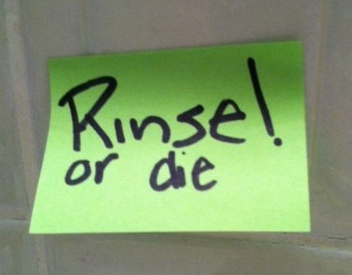
In case you can’t read that, it said “RINSE OR DIE!”
Parenting does not have to be a series of serious teaching lessons all put together. It can be easy to forget this. You can teach, love, learn and grow with fun and laughter. Have a child that asks obvious questions all the time? Find a code word, like “marshmallows” that tells them they are asking a question they already know the answer to and use it whenever they ask nonsense questions.
Kid: “What’s for dinner (while they are staring at you cooking a hamburger)”
Parent: “Marshmallows.”
Kid: “When are we going to get there?” (on a trip they have been on 100 times).
Parent: “When we pass the sign with the marshmallows on it.”
Kid: “Do I have to do my homework?”
Parent: “Just do it until you get to the part about the marshmallows.”

Marshmallow Nightmares!! (Photo credit: katerha)
It might drive them crazy, but it keeps you a little more sane while you focus on a fun way to fit more marshmallows into your life.
Laugh together over silly jokes or silly things they say. Make sure you are laughing with not at. No one like to feel like people are laughing at them but laughing together as a family brings your family closer and reminds us why we brought these “no-rent paying, mess making little people,” as my husband likes to say, into your home in the first place.
How do you laugh with your family? Please fell free to share a funny story that makes you smile 🙂
About me

Kate Oliver, LCSW-C (Licensed Clinical Social Worker) has been a clinician working with traumatized and attachment-disturbed children for almost two decades. She is co-owner of A Healing Place, a private practice in Columbia, Maryland, since 2007.
At the beginning of her career, Kate found that while some children responded to traditional child therapy practices, there were a significant number of children who showed little or no improvement in their overall emotional well-being. This led her to seek out specialized training to learn more about attachment, the bond between parents and children, and found that by using attachment-based strategies in addition to treating trauma, even the most challenging children and their parents, saw major, life-changing shifts, not only for the children she was working with, but the parents as well.
Early in her career, Kate was privileged to work as the clinical director for Tamar’s Children, a program that took pregnant, incarcerated women from prison to a treatment facility that worked on teaching the women to bond with and attach to their babies, while also helping the women to heal their own broken attachments, and history of trauma and addiction. This program was internationally recognized for having a successful, evidence-based practice using an attachment-based model. From working with some of the most severely disenfranchised parents, Kate received important information about how to help all parents maintain a happy, healthy relationship with their children.
In 2007, Kate co-founded A Healing Place, a mental health private group practice in Columbia, Maryland, where she focuses on working with families with children who have a history of trauma and/or attachment disturbances. A board certified supervisor, Kate has been an invited presenter to teach continuing education courses for other social workers and psychologists. In her courses, Kate teaches attachment-building techniques and presents about her sub-specialty, working with families headed by gay and lesbian parents. Kate has also worked as a trainer for Building Families for Children, a therapeutic foster care agency.
Kate is a former board member for the organization COLAGE, a non-profit group that works toward community building for people with gay, lesbian, bisexual and/or transgender parents. She is currently a member of Attachment Disorders Maryland, a group that works to educate parents and professionals about working with children with attachment related issues. She is a Trust-Based Relational Intervention (TBRI) Practitioner and Educator.
Kate lives in Columbia, Maryland is the mother of two amazing daughters, the partner to a fantastic husband, and the daughter of one mother and two gay dads. She loves to read any book that crosses her path, write (of course), and she recently started dancing again, a passion she has had since her youth.
Kate can be reached by email: helpforyourfamily@gmail.com for questions or you can find her on Facebook: http://www.facebook.com/#!/Help4yourfamily.
-
Recent
- 6 Tips for Connecting with Your Teenager
- Updates and New Content on the Way
- Making Peace With Your Inner Critic
- Happy Parent Tip #1
- Why Sexual Abuse is Never a Child’s Fault…Not Even a Teenager
- Naming Patterns Changes Patterns
- This is your brain on attachment
- Last Chance for Two Great Opportunities
- Mother’s Retreat Weekend- It’s Really Happening!
- Stopping the Parent Shame and Blame Game
- Making Peace With Your Inner Critic
- Putting together something fun for you!
-
Links
 help4yourfamily